Deity of the Week: Apollo

Apollo is one of the amazing Greek gods whose ancient presence still feels immediate. He is the god of the lyre and the bow, of prophecy and purification, of plague and healing, of radiant order and sudden judgment. That range makes him especially compelling for modern witchcraft, where devotion often blends myth, symbol, ritual, and personal experience.
For mythology lovers, Apollo offers some of the most memorable stories in the Greek tradition. For practitioners, he offers a clear current of magic: light, truth, art, discipline, divination, protection, and sacred speech.
Honoring Apollo today does not require recreating ancient religion perfectly. Some devotees follow Hellenic reconstructionist methods with careful attention to historical practice. Others work in eclectic witchcraft, building respectful rituals from mythic themes, offerings, symbols, and intuition. Both approaches can find value in Apollo’s many faces.
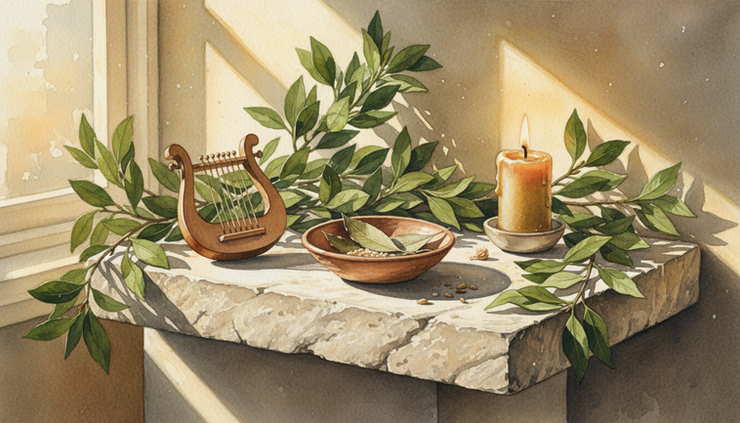
Apollo’s mythic presence still shapes modern devotion
Apollo is the son of Zeus and Leto, and the twin brother of Artemis. In myth, Leto faced persecution while pregnant, and the island of Delos became the place where she gave birth. Apollo’s association with Delos made the island one of his sacred centers.
Soon after his birth, Apollo claimed his prophetic power. One of his most important myths tells how he slew the Python, a serpent or dragon connected to the site of Delphi. Apollo then established his oracle there, where the Pythia gave prophetic responses. This myth is central to his identity as a god of divination, but it also shows one of his deeper themes: the ordering of wild, chthonic, or chaotic forces into sacred speech.
Apollo is not only gentle light. He can be severe. In the Iliad, he sends plague with his arrows when dishonor is done to his priest. Yet he is also invoked as a healer. This dual nature matters in witchcraft because Apollo teaches that light is not always soft. Sometimes illumination exposes what must be corrected.
Several myths reveal the cost of pride, desire, and rejection. His pursuit of Daphne ends with her transformation into a laurel tree, which becomes sacred to him. Cassandra receives prophecy from Apollo, but when conflict rises between them, her true visions are cursed to be disbelieved. His love for Hyacinthus ends in grief, and the flower becomes a sign of beauty, loss, and remembrance.
These stories resist a flat reading of Apollo as simply “the sun god.” In earlier Greek tradition, Helios is the personified sun, while Apollo’s solar identity becomes stronger over time. In modern practice, many witches honor Apollo through sunlight because it fits his radiance, clarity, and later associations. Still, his power is broader than solar magic alone.
Apollo’s epithets reveal different magical faces
Epithets are sacred titles. They show how a god was known in different places, roles, and relationships. In modern devotion, epithets help practitioners call on a specific aspect of Apollo rather than approaching him in a vague way.
Epithet | Meaning and devotional focus |
Phoebus | “Bright” or “shining.” Used for clarity, illumination, and truth. |
Pythios | Apollo of Delphi and the Python myth. Used for divination and oracle work. |
Mousagetes | Leader of the Muses. Used for music, poetry, study, and creative skill. |
Paean | Healer and song of healing. Used for prayers of wellness, comfort, and recovery support. |
Loxias | The obscure or indirect one. Used when seeking meaning in dreams, omens, or complex messages. |
Alexikakos | Averter of evil. Used for protection, cleansing, and banishing harmful influence. |
Agyieus | Guardian of streets, doorways, and public paths. Used for threshold protection. |
Delphinios | Connected with dolphins and seafaring guidance. Used for safe travel and spiritual direction. |
Nomios | Pastoral Apollo. Used for protection of animals, land, and simple daily order. |
Smintheus | Mouse Apollo, associated with plague and its turning away. Used carefully in rites of protection and relief. |
An epithet can change the entire tone of a rite. Lighting a candle to Phoebus Apollo feels different from invoking Apollo Loxias before a tarot reading. Calling on Apollo Mousagetes before writing a song carries a different charge than praying to Apollo Alexikakos for protection.
This is one reason Apollo fits so well into modern witchcraft. His epithets give structure. They let a practitioner be specific.
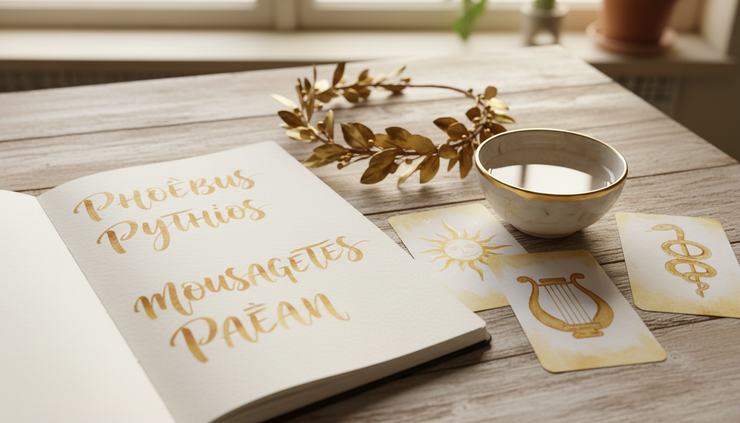
Symbols of Apollo in witchcraft
Apollo’s symbols are rich because they connect to several magical currents at once. A witch might use them on an altar, in spell jars, in devotional art, or as meditation anchors.
Common symbols linked with Apollo include:
Laurel
Sacred because of Daphne’s myth. Laurel is used for victory, purification, prophecy, and poetic inspiration.
Lyre
A sign of music, harmony, measured beauty, and the civilized arts. Hermes gives Apollo the lyre in myth, creating a bond between invention and sacred order.
Bow and arrows
Symbols of distance, precision, plague, protection, and focused intention. Apollo’s arrows can harm or defend.
Tripod
The Delphic oracle’s seat. It represents prophecy, sacred speech, and messages from the divine.
Raven or crow
Birds tied to messages and omen-reading. In some traditions, Apollo’s raven is linked with prophecy and difficult truth.
Swan
A bird of beauty, music, and liminal grace. Swans are often linked with poetic and divine song.
Dolphin
Connected to Apollo Delphinios, travel, guidance, and his arrival at Delphi in dolphin form in some traditions.
Sunlight
Especially common in modern devotion. Sunlight can represent truth, vitality, purification, and clear sight.
The number seven
Apollo is often linked with the seventh day of the month in ancient Greek practice, especially in devotional observance.
Colors often used for Apollo include gold, white, yellow, and sometimes deep blue for his oracular and Delphic aspects. Incense choices might include frankincense, bay laurel, myrrh, rosemary, or cinnamon, depending on the rite and personal tradition.
How Apollo influences modern witchcraft practices
Apollo’s attributes map naturally onto several areas of witchcraft.
Divination and oracular work
Apollo Pythios and Apollo Loxias are powerful figures for divination. His messages in myth are rarely casual. They are layered, poetic, and sometimes difficult. This makes him a strong patron for tarot, oracle cards, scrying, dream interpretation, bibliomancy, and automatic writing.
A simple Apollo divination practice might include:
Clean the space with sound, incense, or fresh water.
Light a white or gold candle.
Say, “Apollo Pythios, guide my sight toward truth.”
Pull one to three cards or gaze into a bowl of water.
Record the answer without forcing it to be simple.
Thank him with song, poetry, or a small offering.
Apollo’s divinatory style often favors clarity, but not always comfort. A reading under his influence may point directly to avoidance, pride, false hopes, or the need for discipline.
Cleansing and purification
Apollo’s connection to miasma, plague, and purification makes him useful in cleansing rites. In ancient Greek religion, purification was a serious spiritual practice. In modern witchcraft, this can become ritual washing, smoke cleansing, floor washes, sunlight cleansing, or sound work.
For a Sunlit Laurel Cleansing, place bay leaves or laurel leaves in a bowl of clean water. Set it where sunlight can touch it for a short time. Use the water to wipe a ritual tool, doorframe, or altar surface. Speak a simple charm:
Bright Apollo, opener of clear ways, burn away confusion, cleanse what remains, let this place be fit for truth.
Do not use ritual cleansing as a substitute for medical care, mental health support, or practical safety steps. In spiritual practice, Apollo’s healing and purifying roles can support intention, reflection, and care.
Creative magic and devotion through art
Apollo Mousagetes leads the Muses. For writers, singers, dancers, painters, and musicians, devotion to Apollo can be as simple as making art consistently.
A creative offering does not need to be perfect. In fact, Apollo’s myths often warn against arrogance around skill. What matters is sincere practice.
Devotional creative acts can include:
Singing a hymn at sunrise
Practicing an instrument as an offering
Writing a poem on the seventh day of the month
Painting a laurel wreath or tripod
Reading Greek hymns or modern devotional poetry aloud
Keeping a notebook of dreams, symbols, and omens
Apollo’s magic rewards attention. A musician tuning an instrument, a poet choosing the exact word, or a witch arranging an altar with care all take part in his sacred order.

Rituals and spells associated with Apollo
The following examples are modern devotional practices inspired by Apollo’s myths, epithets, and symbols. They can be adapted for solitary work or group ritual.
A morning offering to Phoebus Apollo
This rite suits daily devotion, especially at sunrise or in the early morning.
Gather:
A gold or white candle
A cup of clean water
Laurel or bay leaf
Incense, if safe for your space
A short hymn, poem, or spoken prayer
Light the candle and face the morning light if possible. Place the laurel near the candle. Offer the water and say:
“Phoebus Apollo, bright one, receive this offering. Bring clarity to my words, steadiness to my hands, and truth to my path.”
Read a hymn or speak from the heart. Sit quietly for a few moments. When finished, extinguish the candle safely. Pour the water outside near a healthy plant, or dispose of it respectfully.
A truth and clarity spell with Apollo Loxias
Use this when a situation feels tangled and you need insight rather than comfort.
Gather:
A white candle
A bay leaf
A pen
A bowl of water
A divination tool, if desired
Write the core question on the bay leaf. Keep it short. Light the candle and place the leaf beside the bowl.
Say:
“Apollo Loxias, whose words bend toward truth, show me what I cannot see clearly. Let illusion loosen. Let wisdom remain.”
Gaze into the water or perform a short reading. Write down every impression before interpreting it. Afterward, burn the bay leaf safely in a fireproof dish, or tear it and throw it away outside the home. Wash your hands to close the work.
A protection charm to Apollo Alexikakos
This spell focuses on turning away harm and confusion.
Gather:
A small drawstring bag
Bay leaf
Rosemary
A pinch of salt
A small piece of sunstone, clear quartz, or a simple white stone
Yellow thread
Place the herbs, salt, and stone in the bag. Tie it with yellow thread while saying:
“Apollo Alexikakos, averter of harm, stand at the threshold. Let malice miss its mark. Let truth guard this place.”
Keep the charm near a doorway, in a bag, or on an altar. Refresh it monthly or when it feels dull.
A healing support prayer to Apollo Paean
This is a devotional prayer for comfort, strength, and wise care. It does not replace medical advice or treatment.
Light a white candle and offer clean water, honey, or a simple song. Say:
“Apollo Paean, healer through song and light, bring courage, patience, and clear guidance. Help the right care be found. Help the body and spirit move toward balance.”
Sit in silence, hum, or play gentle music. Let the prayer be less about forcing an outcome and more about asking for support, steadiness, and wisdom.
Honoring Apollo with respect today
Modern devotion works best when it balances inspiration with respect. Apollo belongs to a living field of study, history, and religious revival. His myths come from ancient cultures, and many modern Hellenic polytheists honor him as a real deity, not just an archetype.
That does not mean every witch must practice the same way. It does mean care matters.
Respectful devotion can include:
Learning from ancient hymns, myths, and historical sources
Using epithets with intention
Making regular offerings rather than only asking for favors
Avoiding claims that ancient people all believed one simple thing
Giving space to both beauty and severity in Apollo’s nature
Treating divination as sacred dialogue, not entertainment alone
Apollo can also help modern practitioners resist spiritual vagueness. His presence asks for precision. Are the words true? Is the ritual clean? Is the offering sincere? Is the art practiced, not only imagined? Is the message clear enough to act on?
That demand can feel exacting, but it is also a gift.

Why Apollo matters in contemporary spirituality
Apollo speaks strongly to the present because his domains meet real spiritual needs. Many people seek clarity in a noisy world. Many want devotional practices connected to art, study, and divination rather than only seasonal cycles or folk magic. Many want a god who values beauty but does not reduce spirituality to comfort.
Apollo offers:
Clarity without denial
Creativity with discipline
Healing prayer with wise boundaries
Divination with responsibility
Protection through truth and purification
Devotion rooted in song, study, and light
He is radiant, but not shallow. He is beautiful, but not harmless. He is a god of music who carries a bow, a healer who can send plague, an oracle whose answers demand interpretation.
For the modern witch, that complexity is the point. Apollo encourages a practice that is clean, artful, truthful, and brave. To honor him is to make room for sacred brightness, the kind that reveals dust on the altar, falsehood in the heart, and the next clear step forward.


Comments