Deity of the Week: Helios

Helios is more than a bright figure in the sky. In Greek myth, he is the living Sun, a watchful god who sees what others miss, crosses the heavens each day, and brings light to gods and mortals alike.
To ancient Greeks, the Sun was not only a natural force. It was divine presence, order, sight, witness, warmth, and power. Helios stood at the center of that vision. He rose from the eastern edge of the world, drove his radiant chariot across the sky, and descended in the west before returning by night to begin again.
Today, Helios still draws devotion from Hellenic polytheists, witches, pagans, and spiritual seekers who feel called to solar magic, truth, vitality, and clear purpose. His myths reveal a deity who is brilliant, observant, intense, and deeply tied to the rhythm of daily life.

Helios stands at the heart of Greek solar myth
Helios belongs to the older divine generation of the Titans. He is usually named as the son of Hyperion and Theia, both associated with heavenly light. His sisters are Selene, the Moon, and Eos, the Dawn. Together, these siblings form a celestial family that marks the great cycles of the sky.
Each day, Eos opens the gates of morning. Helios follows, rising in splendor from the east. Selene later brings the moonlit night. This family pattern gives Greek cosmology a sense of movement and sacred order.
Helios is often shown as a beautiful, powerful god crowned with rays. His chariot is typically drawn by fiery horses, though the number and names of the horses vary by source. Ancient poets imagined his route as vast and cosmic. He crosses the heavens by day, then returns through the encircling river Oceanus by night.
That daily journey made Helios a god of reliability. He is not a distant symbol of light. He is the one who appears, travels, sees, departs, and returns. His presence marks time itself.
Key myths show Helios as witness, protector, and force of consequence
Helios appears in many stories, sometimes as the central figure and sometimes as the divine witness who knows what happened. That role matters. In Greek myth, seeing is power. Helios sees from above, which makes him difficult to deceive.
Helios reveals the truth about Persephone
One of Helios’s most important roles appears in the story of Demeter and Persephone. When Persephone is taken by Hades, Demeter searches the earth in grief. Few know what happened, but Helios saw the abduction from the sky.
In some versions, Helios tells Demeter the truth. This moment reveals one of his core traits: he is the divine observer. He may not stop every event, but he witnesses it. His knowledge can bring hidden things into the light.
For modern devotees, this story makes Helios a strong presence for truth work, clarity, and honest revelation.
The cattle of Helios test human restraint
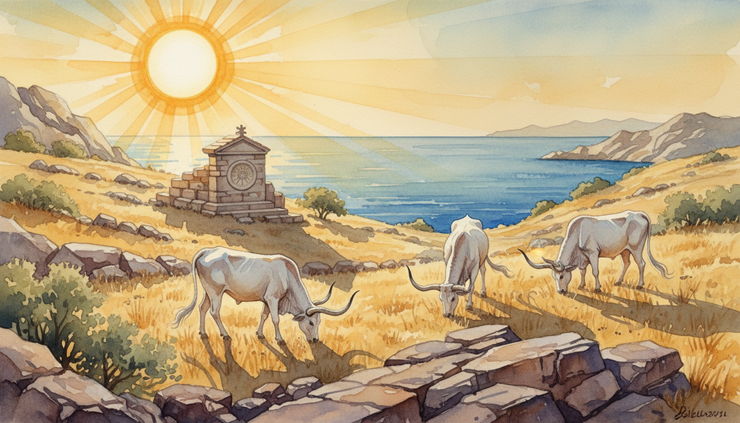
In the Odyssey, Odysseus and his crew reach the island of Thrinacia, where the sacred cattle of Helios graze. They are warned not to harm the animals. While Odysseus is away, his hungry crew slaughter the cattle anyway.
Helios demands justice. Zeus destroys the ship, and only Odysseus survives.
This myth shows that Helios is not only warm and generous. He also guards what is sacred to him. His light nourishes life, but disrespect brings consequence. The story warns against greed, impatience, and the breaking of sacred boundaries.
Phaethon shows the danger of unearned power
The myth of Phaethon, son of Helios, is one of the best-known solar stories. Phaethon asks to drive his father’s chariot to prove his divine parentage. Helios tries to stop him, knowing the task is too great. Bound by his promise, he allows it.
Phaethon cannot control the horses. The chariot veers wildly, scorching the earth and threatening cosmic order. Zeus strikes him down with a thunderbolt to prevent greater ruin.
This story is tragic, but it is also deeply instructive. Solar power is immense. It requires discipline, humility, and skill. Working with Helios means respecting intensity. His gifts can illuminate and strengthen, but they are not toys.
Rhodes held Helios in special honor
Helios had strong ties to the island of Rhodes. Ancient tradition tells that when the gods divided the world, Helios was absent because he was crossing the sky. He later claimed Rhodes, which had risen from the sea, and became its patron.
The famous Colossus of Rhodes, one of the wonders of the ancient world, was a massive statue associated with Helios. Though it no longer stands, it points to how important his worship was in that place.
Rhodes shows Helios as a civic and protective god, not only a mythic driver of the Sun. He could guard a community, bless a land, and stand as a symbol of shared identity.
The epithets of Helios reveal his character
Epithets are descriptive titles used in hymns, poetry, prayer, and cult. They are not random decorations. They tell us how people experienced a deity.
Helios’s titles often focus on light, sight, height, radiance, and divine authority. Taken together, they show him as a god who illuminates, observes, protects, and rules through the power of the Sun.
Epithet | Meaning | What it reveals |
Hyperion | The high one, or son of Hyperion | Helios is linked with heavenly height and the older Titan lineage |
Phaethon | Shining or radiant | His nature is brilliant, fiery, and visible |
Panoptes | All-seeing | He witnesses actions from above and knows hidden things |
Elektor | Beaming or radiant | His light flashes with force and splendor |
Soter | Savior or preserver | In some devotional contexts, solar light protects and sustains life |
Anax | Lord or ruler | Helios carries royal and commanding power |
Ancient sources do not use every epithet in the same way across every region or period. Greek worship was local, poetic, and fluid. Still, these names help modern practitioners approach Helios with more depth.
If you call on Helios as Panoptes, you are approaching the god of witness and truth. If you call on him as Phaethon, you are honoring his radiance and vitality. If you call on him as Soter, you may be seeking preservation, safety, or renewal.
An epithet can shape the tone of a prayer. It tells the deity, and yourself, which face of the god you are turning toward.
Modern devotion to Helios can be simple and steady
Devotion to Helios does not need to be elaborate. Because his power is tied to the daily Sun, consistent small practices often feel more fitting than rare dramatic ones.
A simple devotional rhythm might include:
Greeting the Sun at sunrise
Offering clean water, incense, honey, olive oil, or wine
Lighting a candle in his honor
Reciting an ancient hymn or writing your own prayer
Keeping a solar altar with gold, yellow, white, or orange items
Practicing gratitude for warmth, health, vision, and clarity
Honoring Sunday as a solar devotional day
A Helios altar can be modest. A candle, a bowl of water, a small image of the Sun, bay leaves, citrine, amber, or a drawing of a chariot can all work. The point is not expense. The point is relationship.
For offerings, choose what feels respectful and manageable. Traditional-style offerings such as incense, libations, and hymns fit well. Frankincense is a common solar incense in modern practice. Bay, rosemary, citrus, and sunflowers also carry bright solar associations.
Keep fire safety in mind. Never leave candles unattended. If you make offerings outdoors, avoid anything that could harm wildlife or the land. Pouring clean water as a libation is often enough.

Ritual practices can help build a living connection
A good Helios ritual does not have to be complex. It should feel bright, clean, and focused. Solar devotion benefits from clarity.
Try this short sunrise practice:
Face east, if possible.
Take a few steady breaths as the sky brightens.
Light a candle or hold a cup of water.
Say a simple prayer, such as: “Helios, radiant one, witness of the heavens, bring clarity, strength, and right vision to this day.”
Offer the water outdoors or place it on your altar.
Name one truth you are willing to see clearly today.
This kind of practice works because it matches Helios’s nature. It honors light, rhythm, sight, and truth. Repeating it over time can make the connection feel grounded instead of abstract.
Noon can also be a powerful time for Helios, especially for work related to confidence, visibility, courage, and completion. Sunset suits gratitude, release, and reflection on what the day revealed.
Helios in contemporary witchcraft brings solar force into spellwork
In contemporary witchcraft, Helios works well with magic that centers on illumination, confidence, protection, truth, vitality, and success through honest effort. He is especially helpful when a spell needs clear direction rather than mystery.
Solar witchcraft with Helios may include:
Charging charms in sunlight
Creating protection wards with solar symbols
Burning bay leaves with written prayers
Using gold or yellow candles for courage and clarity
Timing spells for Sunday, sunrise, or noon
Making sun water by placing water in sunlight for a limited time
Calling on Helios before divination for clear sight
Avoid unsafe practices. Do not stare at the Sun. Do not drink sun water that has been left in unsafe containers or exposed to contaminants. If you use crystals, check whether sunlight may fade or damage them.
Helios can also support shadow work, but not in the sense of soft concealment. His light exposes. That can feel bracing. When working with him, ask for truth with steadiness, not truth as a weapon. His presence can help reveal patterns, false promises, and places where pride has outrun wisdom.
The myth of Phaethon is especially useful for witches. It teaches that power needs preparation. If a working feels too intense, scale it down. Begin with prayer, offerings, and observation before asking for major results.
Ways to build a respectful relationship with Helios
A relationship with Helios grows through attention. Watch sunrise colors. Notice how your energy shifts through the day. Track how sunlight changes your home, your mood, and your patterns. Devotion begins with noticing.
Here are a few grounded ways to connect:
Learn his myths
Read about Helios in Greek myth, including his role in the Odyssey, the Homeric and Orphic hymns, and stories tied to Rhodes. Myths give context and help prevent a flat, purely symbolic approach.
Use his epithets in prayer
Try calling him “Helios Panoptes” when asking for truth, or “Helios Phaethon” when seeking vitality and radiance. Let the title match the purpose.
Keep your promises
Helios is tied to witness and oath. If you make a devotional promise, keep it realistic. A small weekly offering is better than a grand vow you cannot maintain.
Honor the physical Sun
Spend safe time outside. Open curtains. Tend plants. Support habits that respect the body’s need for light and rest. Helios is cosmic, but his presence also touches ordinary life.
Practice clean magic
Solar work benefits from clean tools, clear words, and honest aims. Before a Helios spell, ask yourself whether the work can stand in the light.

Helios still shines for those who seek clarity
Helios offers a path of brightness, but not shallow brightness. His myths carry beauty, danger, justice, discipline, and awe. He sees. He reveals. He nourishes. He also reminds people that sacred power deserves respect.
For modern devotees and witches, Helios can be a steady ally in truth work, solar magic, protection, confidence, and daily renewal. Start small. Greet the Sun. Offer water. Speak honestly. Learn his names.
The ancient god who crossed the heavens is still easy to find. Step into the morning light, and begin there.


Comments