Deity of the Week: Aphrodite

Aphrodite is often reduced to a pretty face, a seashell, and a love spell. That misses the force of her. In ancient Greek religion, she was not only the goddess of romance and beauty. She ruled attraction, longing, pleasure, fertility, persuasion, adornment, sexuality, sea-born mystery, and the strange power that pulls one being toward another.
Her myths can be tender, funny, frightening, and sharp. Her worship crossed islands, ports, cities, bedrooms, battlefields, and marriage beds. Today, Aphrodite still speaks to people who want to understand desire without shame, beauty without shallowness, and love without losing themselves.

Aphrodite’s origins begin in sea foam and divine lineage
Aphrodite has more than one origin story, and each reveals a different side of her.
In Hesiod’s Theogony, Aphrodite rises from the sea foam after the severed body of Uranus touches the water. She comes ashore near Cyprus, already radiant, already powerful. This version makes her older than many Olympians and ties her to the raw forces of creation. Desire is not a decoration here. It is part of the engine of life.
In Homer’s Iliad, she appears as the daughter of Zeus and Dione. This origin places her more firmly inside the Olympian family. She becomes part of the divine politics of Olympus, where love, jealousy, pride, and protection all collide.
Both stories matter. The sea-born Aphrodite feels ancient, elemental, and untamed. The Olympian Aphrodite feels relational, personal, and involved in human affairs.
Her cult also shows signs of older cultural connections. Scholars often compare her with Near Eastern goddesses such as Astarte and Ishtar, who were linked with love, sexuality, fertility, and at times war. Cyprus, a major center of Aphrodite’s worship, sat at a crossroads of Greek and Near Eastern influence. That helps explain why Aphrodite can feel both graceful and dangerous, soft and sovereign.
Her key myths reveal love as a living force
Aphrodite’s stories rarely treat love as simple. In myth, desire blesses, exposes, tempts, awakens, and destroys. She gives beauty, but beauty carries consequences.
The Judgment of Paris changes the world
One of Aphrodite’s most famous myths begins with a divine contest. Hera, Athena, and Aphrodite each claim a golden apple marked for “the fairest.” Paris of Troy must choose who deserves it.
Each goddess offers him a gift. Hera offers power. Athena offers victory and wisdom in war. Aphrodite offers the love of the most beautiful mortal woman, Helen. Paris chooses Aphrodite, and his decision helps set the Trojan War in motion.
This myth shows Aphrodite’s domain as more than personal attraction. Desire can alter families, kingdoms, and history. Love is intimate, but it is never only private.
Aphrodite and Ares show passion without polish
Aphrodite is married to Hephaestus in many versions of myth, but she famously takes Ares, god of war, as a lover. When Hephaestus discovers the affair, he traps the pair in a clever net and exposes them before the gods.
The scene is comic, but it is also revealing. Aphrodite’s passion refuses neat social order. Her union with Ares also hints at an older truth: love and conflict often stand close together. Attraction can thrill, but it can also unsettle everything.
Adonis carries the beauty of longing and grief
Adonis is a beautiful youth loved by Aphrodite. His story varies, but he is often killed by a boar, leaving Aphrodite devastated. In later traditions, his death and partial return become tied to cycles of vegetation, mourning, and renewal.
Through Adonis, Aphrodite becomes a goddess of grief as much as pleasure. To love beauty is to know its fragility. To desire what lives is to face change.
Anchises and Aeneas connect Aphrodite to destiny
Aphrodite also loves the mortal Anchises and gives birth to Aeneas. In Greek and Roman tradition, Aeneas becomes an important heroic figure. Roman writers later identify Aphrodite with Venus, making her a divine ancestor of Rome through Aeneas.
This myth gives Aphrodite a dynastic role. Her desire creates lineage, legacy, and sacred ancestry. Love becomes a thread between gods, mortals, and nations.

Aphrodite’s attributes are beautiful, sensual, and symbolic
Aphrodite’s symbols are not random decorations. They express her powers and the ways ancient people understood her presence.
Common attributes include:
The dove
A bird of tenderness, courtship, and sacred affection.
The sparrow
Often linked with erotic energy and lively desire.
The swan
A symbol of grace, beauty, and divine elegance.
The rose
A flower of love, pleasure, softness, and vulnerability.
Myrtle
A sacred plant associated with love, marriage, and Aphrodite’s worship.
The apple
A fruit tied to beauty, temptation, fertility, and the Judgment of Paris.
The shell
A reminder of her sea-born origins and the mystery of emergence.
Gold, mirrors, and adornment
Signs of radiance, self-presentation, allure, and sacred beauty.
These symbols help explain why Aphrodite remains so easy to approach in modern practice. A single rose, a shell from the shore, or a mirror cleaned with care can become a devotional object when offered with intention.
Her epithets reveal many forms of the goddess
Ancient gods were often honored through epithets, names or titles that described specific powers, places, or moods. Aphrodite’s epithets show that she was never only “the goddess of love.” She had many faces.
Epithet | Meaning and significance |
Aphrodite Ourania | “Heavenly Aphrodite.” Often associated with spiritual love, divine beauty, and elevated forms of desire. |
Aphrodite Pandemos | “Aphrodite of all the people.” Linked with communal life, civic bonds, and love as a social force. |
Aphrodite Anadyomene | “She who rises from the sea.” This title honors her famous emergence from the waves. |
Aphrodite Kypris | “The Cypriot.” Cyprus was one of her most important sacred centers. |
Aphrodite Cytherea | A title tied to Cythera, another island associated with her arrival and worship. |
Aphrodite Euploia | “Good sailing.” This reflects her connection with the sea, sailors, safe passage, and favorable journeys. |
Aphrodite Areia | “Warlike Aphrodite.” Worshiped in some places, this form reminds us that love, power, and conflict can meet. |
Aphrodite Philommeides | Often understood as “laughter-loving” or “smile-loving,” pointing to charm, pleasure, and delight. |
Aphrodite Kallipygos | “Of the beautiful buttocks.” A frank title that reflects ancient comfort with embodied beauty and sensual admiration. |
These epithets are useful for modern devotion because they help focus intention. Someone seeking self-acceptance may call on Aphrodite Philommeides. Someone working with ocean magic may honor Aphrodite Anadyomene or Euploia. Someone exploring sacred sexuality with care may turn to Aphrodite Ourania, Pandemos, or Kypris, depending on the tone of the work.
Love, beauty, and desire still matter because they shape daily life
Aphrodite’s themes have not faded. They have only changed clothes.
Modern culture often treats beauty as performance, desire as consumption, and love as a problem to solve. Aphrodite offers a deeper view. Beauty can be a way of perceiving. Desire can reveal what the soul reaches for. Love can become a practice of presence, not just a feeling.
Her mythology also challenges shame. Aphrodite does not ask people to become less embodied. She invites attention to pleasure, art, scent, touch, color, softness, and attraction. That does not mean chasing every impulse. Many of her myths warn against careless desire. Instead, they ask for honesty.
Aphrodite’s wisdom lives in questions like these:
What do I truly find beautiful when no one is watching?
Where has shame dimmed my capacity for pleasure?
What kind of love makes me more whole?
What desires are asking for care rather than denial?
How can I honor my body without turning it into an object?
This is where Aphrodite becomes more than a figure from myth. She becomes a mirror.

Modern devotion can be simple, sincere, and beautiful
Modern devotion to Aphrodite does not require expensive tools or elaborate rituals. Consistency and sincerity matter more than luxury.
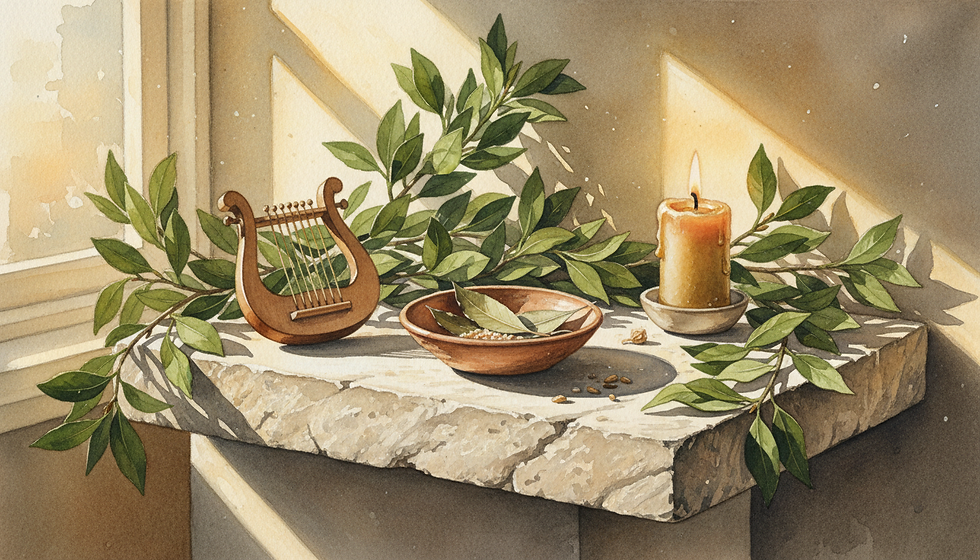
A small altar might include:
A shell or bowl of sea water
Fresh roses or myrtle when available
A mirror
A candle in white, pink, red, or sea green
Apples, honey, wine, milk, or sweet cakes
Incense such as rose, myrrh, frankincense, or sandalwood
Copper, pearls, or ocean stones
Art that evokes beauty, love, or the sea
Offerings can be physical, but they can also be acts. Aphrodite is well honored through bathing, making art, tending flowers, writing love poetry, caring for the body, repairing a relationship, or speaking kindly to the mirror.
A simple devotional practice might look like this:
Clean the space and wash your hands.
Light a candle.
Place an offering on the altar.
Speak one of her names, such as “Aphrodite Kypris” or “Aphrodite Anadyomene.”
Say what you are grateful for.
Sit quietly and notice what feelings rise.
Close by thanking her and disposing of offerings respectfully.
For liquid offerings, some practitioners pour them outside at the base of a plant or into the earth. Food offerings can be composted when appropriate. If leaving anything outdoors, choose items that are safe for local wildlife and the environment.
Aphrodite belongs naturally in contemporary witchcraft
Aphrodite’s energy fits many forms of witchcraft, especially practices related to love, glamour, healing from shame, creativity, confidence, friendship, and pleasure. The key is ethics. Love magic should respect consent. Spells aimed at controlling a specific person cross a line for many practitioners and often create spiritual and emotional mess.
Aphrodite’s magic works beautifully when focused on attraction, openness, self-love, charm, and healthy connection.
Try a mirror blessing for self-love
Clean a mirror with rose water or plain water with a pinch of salt. Light a candle. Look at your reflection without rushing to critique it.
Say:
“Aphrodite of the shining sea, help me see myself with gentleness, truth, and love.”
Name three things you appreciate about yourself. They do not all need to be physical. Beauty includes resilience, humor, softness, courage, and grace.
Create a Venus charm for attraction
On a Friday, traditionally associated with Venus, gather a small pouch with rose petals, a tiny shell, a pinch of cinnamon, and a piece of copper or rose quartz. Hold it near your heart.
Rather than naming a specific person, speak your desire for mutual, joyful, respectful connection. Carry the charm when going on dates, meeting new people, or tending your confidence.
Make a beauty bath into a ritual
A ritual bath can honor Aphrodite Anadyomene, the goddess rising from water. Add rose petals, a little honey, or skin-safe oils. Keep it simple if your skin is sensitive.
As you bathe, imagine shame and harsh self-talk dissolving. When you step out, anoint your wrists with a favorite scent and choose clothing that helps you feel present in your body.
Work with glamour as sacred attention
Glamour magic is not just makeup or appearance. It is the art of shaping how energy is felt and perceived. With Aphrodite, glamour can become a devotional act.
Choose one feature, color, scent, or piece of jewelry as your focus. Bless it at the altar. Ask it to carry a quality such as warmth, confidence, grace, or magnetism. Wear it with intention.
Aphrodite’s presence asks for honesty
Aphrodite is sweet, but she is not shallow. Her myths remind us that beauty can provoke envy, desire can disrupt plans, and love can expose what people try to hide. Working with her calls for emotional honesty.
She may ask for better boundaries. She may reveal where longing has turned into obsession. She may soften a heart that has stayed guarded for too long. She may also teach delight for its own sake, without guilt.
That combination makes her powerful in modern spiritual life. Aphrodite does not belong only to romance. She belongs to friendship, art, pleasure, courage, grief, sensuality, and the daily choice to remain open to beauty.

A living connection with Aphrodite
To connect with Aphrodite, begin with what is real. Bring a flower. Light a candle. Stand near water. Write honestly about desire. Offer honey. Wear something that makes you feel alive. Speak her name with respect.
Aphrodite’s gift is not a perfect romance or a flawless reflection. Her deeper gift is reconnection. She brings the soul back to beauty, the body back to tenderness, and desire back to wisdom.
Approach her as sea-born, golden, laughing, and ancient. Approach her as Ourania, Pandemos, Kypris, Anadyomene. Let her myths warn you, charm you, and wake you up.
Love is not small in Aphrodite’s world. Beauty is not trivial. Desire is not an enemy. Each can become a sacred path when met with reverence, consent, and an open heart.
Comments