Deity of the Week: Eos

Dawn has a strange power. It arrives softly, but it changes everything. The sky lightens, birds begin, shadows loosen, and the world feels briefly possible again.
That threshold belongs to Eos, the Greek goddess of dawn.
In myth, Eos is not a quiet background figure. She is radiant, restless, tender, desirous, and cosmic. She opens the gates of heaven for the sun. She mothers winds and stars. She loves mortals, grieves fiercely, and appears again and again in Greek poetry as the one who brings the day.
For modern witches, pagans, and devotional practitioners, Eos offers a beautiful way to work with renewal, liminal moments, grief, desire, and the courage to begin again.

Who is Eos in Greek mythology?
Eos is the Greek goddess of dawn, known to the Romans as Aurora. In the older Greek tradition, she is a Titaness, a divine being from the generation before the Olympian gods. Her parents are usually named as Hyperion and Theia, making her the sister of Helios, the sun, and Selene, the moon.
This family connection matters. Eos is part of a celestial rhythm:
Selene travels with the moon.
Eos brings the first light.
Helios follows with the sun.
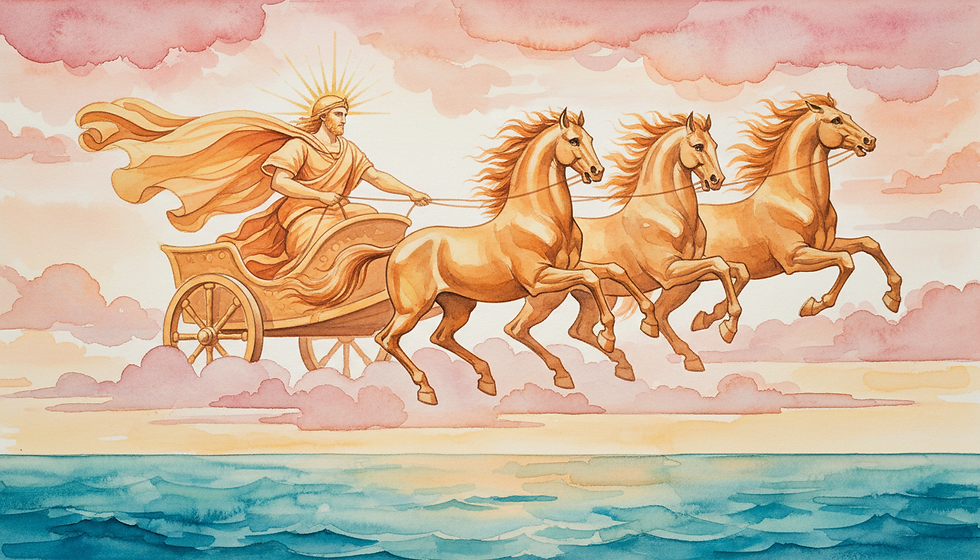
In many myths, Eos rises from the edge of Oceanus, the great world-encircling river. She opens the gates of the sky so Helios can drive his solar chariot across the heavens. Her presence marks the daily transition from darkness to light.
Ancient poets loved her. In Homeric poetry, dawn is not just a time of day. Dawn is a divine arrival. Eos appears as a goddess who touches the world with color, motion, and renewal.
She is also deeply emotional. Her stories are full of love, longing, beauty, and loss. That makes her more than a symbol of morning. She is a goddess of beginnings that carry memory with them.
The epithets of Eos reveal her nature
Greek gods often carry epithets, poetic names or titles that show different parts of their power. Eos has some of the most beautiful epithets in ancient literature.
Rosy-fingered Eos
Her most famous epithet is Rhododaktylos, often translated as “rosy-fingered.”
This image appears often in Homeric poetry. It suggests the pink light of sunrise spreading across the sky like fingers. It is delicate, but also active. Eos does not simply appear. She reaches.
For devotion and witchcraft, this epithet can guide morning work. Rosy-fingered Eos is the goddess who gently touches what was hidden. She reveals without force.
Saffron-robed Eos
Another beloved epithet is Krokopéplos, meaning “saffron-robed.”
Saffron is a golden-orange color linked to the glow of dawn. A saffron robe suggests radiance, richness, and sacred beauty. In ritual, this epithet pairs well with golden candles, orange flowers, saffron-colored cloth, or sunrise-colored altar items.
Early-born Eos
Eos is also called Erigeneia, often understood as “early-born” or “early-rising.”
This title speaks to her timing. She arrives before the full day. She belongs to the first breath, the first step, the first opening of the eyes.
Modern practitioners may call on Eos Erigeneia when starting a project, healing a pattern, returning to discipline, or seeking hope after a hard season.
Golden-throned Eos
The epithet Chrysothronos, or “golden-throned,” points to her majesty. Eos is not only soft morning light. She is royal, luminous, and powerful.
This matters because dawn can be mistaken for something fragile. Eos reminds us that gentleness can still be divine authority.
Eos as a goddess of love, mortality, and grief
Eos is famous for her love affairs with mortals. These stories can feel intense, even tragic, but they reveal why she remains so spiritually compelling.
One of her best-known lovers is Tithonus, a Trojan prince. Eos asks Zeus to grant him immortality, but she does not ask for eternal youth. Tithonus lives forever, but he continues to age. In later tradition, he becomes withered and weak, sometimes transformed into a cicada.
This myth is often read as a warning about careless wishes. In devotion, it can also become a meditation on time. Eos loves what cannot last. She brings a new day, but every day fades.
Another important story involves Memnon, the son of Eos and Tithonus. Memnon fights in the Trojan War and is killed by Achilles. Eos mourns him with deep sorrow. Some traditions connect her tears to the morning dew.
This image is powerful: the goddess of dawn weeping over the beloved dead. Morning light does not erase grief. It holds it.
Eos is also associated with Cephalus, Orion, and other beautiful mortals. Ancient sources sometimes frame her repeated desire for mortals as the result of Aphrodite’s anger after Eos lay with Ares. Whether read literally or symbolically, these myths show Eos as a goddess of longing that crosses boundaries.
She loves across the divide between divine and human. She reaches toward what is temporary.
That is one reason modern devotees often approach her during times of transition, heartbreak, aging, or renewal after loss.
Why Eos matters spiritually today
Eos speaks to people who live at thresholds.
She belongs to the moment before certainty. The sun has not fully risen, but the dark has started to loosen. That makes her a natural goddess for anyone working through change.
Her spiritual themes include:
New beginnings
Starting again after failure, grief, exhaustion, or delay.
Gentle revelation
Seeing the truth without being overwhelmed by it.
Creative awakening
Returning to art, writing, music, study, or spiritual practice.
Time and mortality
Accepting that beauty and impermanence often arrive together.
Hope with honesty
Welcoming light without pretending pain never happened.
This is what makes Eos Goddess of Dawn Epithets Mythology and Modern Witchcraft Rituals such a rich subject. Her ancient epithets are not museum pieces. They still offer language for spiritual experience.
A person does not have to worship the Greek gods in a formal reconstructionist way to feel drawn to Eos. Some do approach her through Hellenic polytheism, with offerings and hymns shaped by ancient practice. Others meet her through eclectic witchcraft, poetry, daily prayer, or sunrise meditation.
Both paths benefit from respect. Eos is not just an aesthetic. She is a goddess with a long mythic history, and approaching her with care gives the relationship depth.

Working with Eos in contemporary witchcraft
Modern witchcraft often values timing, symbolism, and relationship. Eos fits naturally into all three.
The best time to honor her is dawn, especially the minutes before sunrise. That said, devotion should fit real life. If waking before sunrise is not possible, use another threshold time, such as opening the curtains, lighting the first candle of the day, or stepping outside before beginning work.
Offerings for Eos
Offerings do not need to be expensive. In many devotional traditions, sincerity matters more than display.
Good offerings for Eos include:
Fresh water in a clean bowl
Honey or honeyed tea
Saffron, crocus, or marigold
Rose petals or pink flowers
Frankincense, myrrh, or light floral incense
A golden, pink, white, or orange candle
Poetry, hymns, song, or spoken praise
The first breath of gratitude in the morning
If you make food or drink offerings, dispose of them respectfully. Some practitioners pour water at the base of a plant. Others leave flowers outside when appropriate. Keep local wildlife and the environment in mind.
Magical intentions aligned with Eos
Eos is especially suited to spells and rituals for:
Fresh starts
Healing after grief
Confidence at the beginning of a new path
Clarity after confusion
Creativity and inspiration
Morning discipline
Releasing what belongs to the night
Blessing travel, especially at the start of a journey
Her magic is not harsh. It feels like illumination, not interrogation. She helps reveal what is ready to be seen.
A simple dawn devotion to Eos
This is a gentle practice I return to when life feels heavy or scattered. It takes less than ten minutes, but it changes the tone of the day.
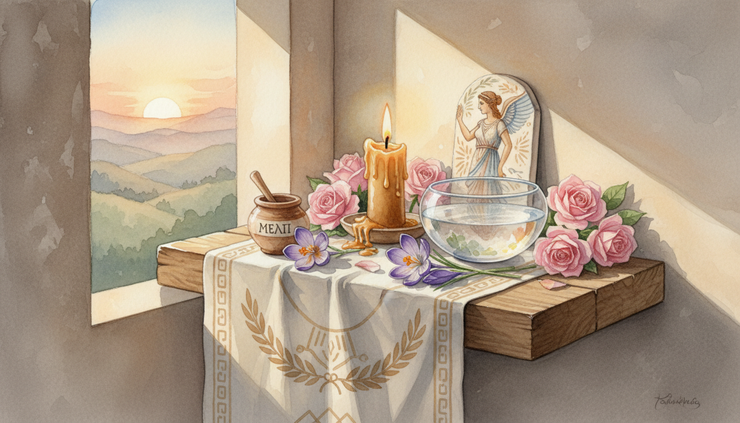
Before sunrise, place a candle near a window. Use pink, gold, white, or orange if you have one. Set a small bowl of water beside it.
Light the candle and say:
Eos, rosy-fingered goddess, opener of the gates of day, bring light to what is ready to rise. Let me begin again with clear eyes.
Then dip your fingers into the water and touch your forehead, heart, and hands.
Say one thing you are ready to release. Say one thing you are ready to welcome.
Sit quietly until the sky changes. Watch the light shift, even if only for a minute. When you are done, thank Eos and snuff the candle.
This ritual works because it is simple. Eos does not need performance. Dawn itself is the temple.
A personal way to build relationship with Eos
My most meaningful experiences with Eos have come during difficult mornings, not perfect ones.
There is a particular kind of dawn that arrives after a sleepless night. The mind is tired. The body feels raw. The first light can feel almost too honest. In those moments, Eos feels less like a bright goddess of cheerful beginnings and more like a companion at the edge of endurance.
One practice that has helped is writing a single sentence at dawn. Not a full journal entry. Not a polished prayer. Just one true sentence.
Some examples:
“I am still here.”
“I do not know what comes next, but I can meet this hour.”
“May the light reach the places I have avoided.”
“Beloved Eos, teach me how to begin without rushing.”
Over time, those sentences become a record of survival and renewal. They show how spiritual practice can be small and still real.
Another beautiful practice is to greet Eos when opening the curtains. This turns an ordinary motion into devotion. As the light enters the room, whisper one of her epithets:
Rosy-fingered one, enter.
Saffron-robed one, bless this day.
Early-born one, guide my beginning.
Ritual does not always need a circle, tools, or a long script. Sometimes it is the choice to notice.
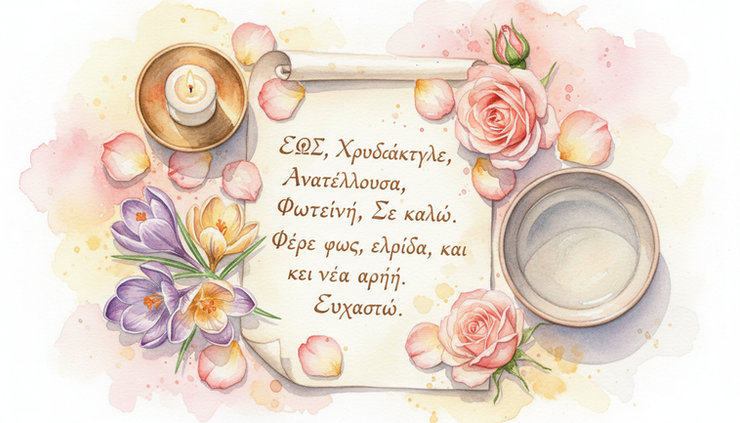
A longer Eos ritual for renewal
Use this ritual when beginning a new chapter, after grief, before a creative project, or at the start of a personal healing season.
Gather:
A candle in dawn colors
A bowl of water
A small mirror
Honey or tea
A flower or petal
A journal and pen
Begin just before sunrise if possible.
Place the mirror facing the candle, with the bowl of water between them. The mirror represents revelation. The water represents the emotional body. The candle represents the first light.
Light the candle and speak:
Eos Erigeneia, early-born dawn, rise before me and within me. Open the gates of this day. Teach me what may now begin.
Look into the water, not the mirror yet. Name what you are leaving behind. Keep it brief and honest.
Then touch the flower or petal to the rim of the bowl. Say:
What has ended may be honored. What is beginning may be blessed.
Now look into the mirror. Do not search for anything dramatic. Simply meet your own eyes in the growing light.
Ask one question:
What part of me is ready to return?
Write whatever comes. Even if the answer is only a word, keep it.
Share a small offering of honey or tea with Eos. You might sip some and place a portion aside for her. Thank her by name, using any epithet that feels alive to you.
Let the candle burn safely for a short time, then extinguish it. Carry the written answer with you, or place it on your altar for the next lunar cycle.
Walking with Eos beyond the ritual
The deepest devotion to Eos may be consistency.
Greet the morning. Notice the colors of the sky. Learn the names of the birds that call before sunrise. Track how dawn changes through the seasons. Let the first light touch your face before you reach for your phone. Offer gratitude before the day asks anything from you.
Eos teaches that beginnings are sacred, even when they are imperfect.
She does not promise that every dawn will feel easy. Her myths do not deny sorrow, aging, longing, or loss. Instead, she arrives anyway. Pink-fingered, saffron-robed, early-born, golden-throned. She opens the gates.
To connect with Eos, start small. Wake once with intention. Light one candle. Speak one true sentence. Watch the sky shift from dark to rose to gold.
That is enough for a beginning. And beginning is her gift.


Comments