Deity of the Week: Hermes

Hermes is hard to pin down, and that is the point. He moves through thresholds, roads, dreams, markets, jokes, thefts, messages, and the quiet passage between life and death. In Greek myth, he is the god who can enter almost anywhere. Olympus, the underworld, a shepherd’s field, a traveler’s path, a bedroom, a battlefield, a shrine at a crossroads, all fall within his reach.
That makes Hermes especially compelling for modern spiritual practice. He is playful, quick, protective, clever, and deeply liminal. He can bless the traveler, sharpen the writer’s tongue, guide the dead, guard the boundary, and teach the witch how to move with skill through uncertain spaces.
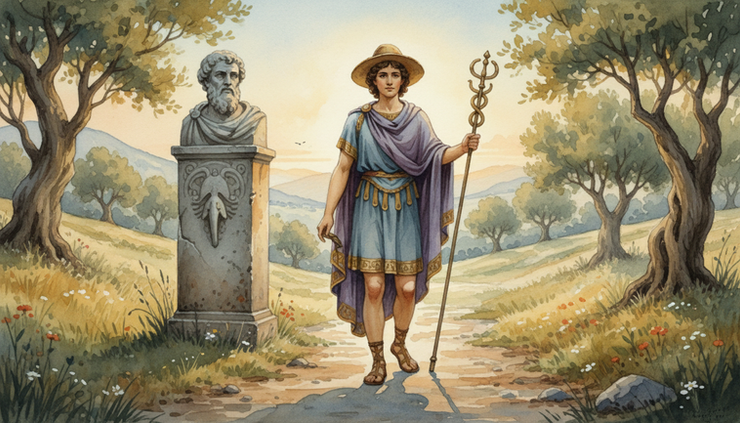
Hermes in Greek religion and myth
Hermes is the son of Zeus and Maia, one of the Pleiades. Ancient sources often place his birth in a cave on Mount Cyllene in Arcadia, a region tied to shepherds, wild hills, and older rustic worship. From the start, Hermes is not a distant or solemn god. He is active at once.
The Homeric Hymn to Hermes gives one of the clearest portraits of his nature. On the day he is born, he leaves his cradle, invents the lyre from a tortoise shell, steals Apollo’s cattle, hides the evidence with clever tricks, and then talks his way through the conflict. When Apollo discovers the theft, Hermes does not simply deny it. He performs innocence with such wit that the scene becomes comic, then transformative. The lyre becomes a gift to Apollo, and Hermes receives honor, friendship, and eventually the role of divine messenger.
That myth matters because it shows several sides of Hermes at once:
He crosses limits before anyone gives him permission.
He uses intelligence more than force.
He turns conflict into exchange.
He creates sacred tools from ordinary things.
He speaks with charm, speed, and nerve.
Hermes is not only a trickster. He is also a mediator. His tricks often reveal movement, trade, negotiation, and the unstable nature of boundaries. He teaches that a locked door may still have a hinge.
Key epithets of Hermes and what they mean
In ancient Greek religion, epithets were more than poetic nicknames. They named a god’s role, local presence, or specific power. Calling Hermes by an epithet helped worshippers approach the aspect of him they needed.
Epithet | Meaning and focus |
Cyllenius | “Of Cyllene,” linking Hermes to Mount Cyllene, his Arcadian birthplace. This epithet points to his rustic, regional, and mountain-born origins. |
Argeiphontes | Often translated as “slayer of Argus.” It refers to Hermes killing the many-eyed giant Argus Panoptes while freeing Io. This title highlights stealth, cunning, and divine service. |
Psychopompos | “Guide of souls.” Hermes leads the dead to the underworld, making him a sacred guide through the last threshold. |
Chthonios | “Of the earth” or “underworldly.” This form connects Hermes with the dead, hidden powers, burial, and the realm below. |
Enodios | “Of the road” or “on the way.” This is Hermes as guardian of travelers, paths, crossroads, and movement. |
Hodios | Another road-related title, tied to journeys and safe passage. |
Agoraios | “Of the agora,” the public market and civic gathering place. This Hermes watches over trade, speech, bargaining, exchange, and public life. |
Logios | Connected with speech, reason, words, and eloquence. This is a powerful epithet for writers, speakers, translators, and students. |
Kerdôos | Associated with gain and profit. This does not have to mean greed. It can mean skillful exchange, useful luck, and fair increase. |
Dolios | “Crafty” or “wily.” This title honors Hermes as clever, subtle, and capable of deception. In practice, it calls for discernment and ethics. |
Nomios | Linked with pastures and shepherds. This Hermes belongs to flocks, herds, rural boundaries, and pastoral life. |
Kriophoros | “Ram-bearer.” This image of Hermes carrying a ram connects him with protection, fertility, and pastoral care. |
Propylaios | “Before the gate.” Hermes stands at entrances, thresholds, and doorways, guarding what passes in and out. |
Trismegistos | “Thrice-greatest.” This title belongs mainly to later Greco-Egyptian and Hermetic traditions, where Hermes merges with the Egyptian Thoth as Hermes Trismegistus. |
These names show how broad Hermes is. He is not only “the messenger god.” He is a god of motion, meaning, exchange, threshold, luck, and transition.

Major myths that reveal Hermes’ character
Hermes appears in many myths, often at key turning points. He rarely stays still long enough to dominate a story, but when he appears, movement begins.
Hermes steals Apollo’s cattle
This is the classic Hermes myth. As a newborn, he steals Apollo’s cattle and hides their tracks by making them walk backward. He also invents the lyre, then uses it to settle the dispute.
The story frames Hermes as an inventor, thief, musician, negotiator, and sacred boundary-crosser. He breaks order, then creates a better relationship through exchange. The theft is not random crime. It becomes the origin of divine friendship and new sacred arts.
Hermes slays Argus
Zeus sends Hermes to rescue Io, who is guarded by Argus Panoptes, the many-eyed giant. Hermes lulls Argus to sleep, often through music or storytelling, then kills him.
As Argeiphontes, Hermes acts through patience, charm, and precision. This myth shows him as a stealthy agent of divine will. It also links him with altered states, story, and the power of attention.
Hermes guides souls to the underworld
In the Odyssey and other traditions, Hermes serves as Psychopompos. He guides the souls of the dead to Hades. This is one of his most solemn roles.
For modern devotees, this aspect of Hermes can be tender and profound. He is not death itself. He is the guide who knows the road. His presence can bring comfort in ancestor work, grief rituals, and meditations on change.
Hermes helps Perseus
In the myth of Perseus, Hermes assists the hero by providing guidance and, in many versions, the curved blade used to behead Medusa. Athena also plays a major role. Hermes’ help is practical, direct, and tied to movement through danger.
Here, Hermes supports skill under pressure. He does not remove the trial. He gives the tools to pass through it.
Hermes protects Odysseus from Circe
In the Odyssey, Hermes gives Odysseus the herb moly to protect him from Circe’s magic. He also explains how Odysseus should act.
This is one of the clearest mythic links between Hermes and magical protection. He brings knowledge at the right time. He teaches that enchantment can be met with preparation, courage, and a clear head.
Hermes escorts Priam in the Iliad
In the Iliad, Hermes guides King Priam safely into the Greek camp so he can ransom the body of his son Hector from Achilles. This moment is quiet, dangerous, and deeply human.
Hermes acts as guide through enemy territory. He protects a grieving parent on an impossible road. This is Hermes at his most compassionate: a god of passage, diplomacy, and mercy.
Symbols and sacred signs of Hermes
Hermes is easy to recognize in art, though some of his famous features developed and shifted over time.
Common symbols include:
The kerykeion or caduceus
A herald’s staff, often shown with two serpents. It represents message-bearing, negotiation, and protected passage.
The petasos
A traveler’s hat, sometimes winged in later imagery.
Winged sandals
A sign of speed, divine movement, and freedom between realms.
The tortoise
Linked to the invention of the lyre.
The rooster
A dawn animal, connected with alertness and new beginnings.
Coins and purses
Signs of trade, gain, exchange, and luck.
Herms
Stone boundary markers associated with roads, doorways, and protection.
For modern practice, these symbols can become altar items, meditation images, charm designs, or devotional cues. A key on a small tray, a coin set aside before travel, or a written prayer tucked into a shoe can all speak Hermes’ language.

Modern devotion to Hermes
Modern devotion to Hermes varies widely. Some people approach him through Hellenic polytheism, with attention to ancient sources and ritual forms. Others meet him through eclectic paganism, witchcraft, Hermetic study, or personal devotional practice.
A simple devotional structure might include:
Clean the space
Wash your hands, clear the altar, or light incense. Purity in ancient Greek practice often involved clean water and mindful preparation.
Call him by name and epithet
Choose the form that fits the purpose. For travel, call Hermes Enodios. For writing, Hermes Logios. For ancestor work, Hermes Psychopompos.
Offer something appropriate
Traditional-style offerings may include water, wine, olive oil, honey, bread, fruit, incense, or coins. Modern offerings might include poetry, language study, acts of hospitality, or helping someone navigate a difficult process.
Speak clearly
Hermes favors words. Say what you mean. If asking for help, be direct and respectful.
Follow through
If you promise an offering, give it. If you ask for safe travel, drive responsibly. Devotion is relationship, not vending machine magic.
Many devotees honor Hermes on Wednesdays because of the Roman Mercury connection and the planetary association with Mercury. Others choose the fourth day of the month in a Hellenic-inspired rhythm, since the fourth was associated with Hermes in some ancient calendars. Either approach can work if done with consistency and respect.
Hermes in contemporary witchcraft
Hermes fits naturally into contemporary witchcraft because witchcraft often deals with thresholds: between seen and unseen, intention and action, ordinary and sacred, known and unknown.
He can be called on for:
Road-opening work
Communication spells
Divination and dream messages
Travel protection
Boundary magic
Luck and opportunity
Trade and negotiation
Learning languages or sacred texts
Ancestor work and psychopomp rites
Spellwork involving speed, wit, and adaptation
When working with Hermes, ethics matter. His trickster nature does not excuse manipulation, theft, or careless spellwork. Hermes can teach cleverness without cruelty. He can teach strategy without dishonor. A witch who works with him well learns timing, consent, and clean exits.
A simple Hermes road-opening practice can be done with a candle, a key, and a coin.
Place the key and coin beside the candle. Call Hermes Enodios or Propylaios. Name the path that needs opening. Ask for the right road, not just the fastest one. When the candle has burned safely for a set time, carry the coin as a charm or give it away at a crossroads, donation box, or place connected with travel.
For communication magic, write the message you need to deliver or understand. Place it under a small image or symbol of Hermes, such as a wing, staff, or coin. Ask Hermes Logios to bring clarity, truthful words, and the right timing. Then do the practical work: send the email, make the call, revise the poem, have the conversation.
How to connect with Hermes in daily life
Hermes often arrives through motion and attention. Connection does not always require a formal altar. Daily practice can be simple and alive.
Try any of these:
Greet him before travel
Say a short prayer before driving, flying, biking, or walking a new route.
Keep a Hermes coin
Carry a coin dedicated to him for luck, trade, and safe passage.
Practice skillful speech
Tell the truth with tact. Learn a new word. Write a letter. Study rhetoric, poetry, or translation.
Honor thresholds
Keep your doorway clean. Place a small charm near the entrance. Pause before crossing into important spaces.
Feed your curiosity
Read widely. Follow a question. Let one subject lead to another.
Make offerings through action
Help a lost person find their way. Support travelers, delivery workers, refugees, or people in transition when you can.
Notice signs without forcing them
Hermes may speak through repeated road imagery, sudden useful messages, jokes, birds at dawn, found coins, dreams, or strange timing. Stay grounded. A sign should deepen awareness, not replace judgment.
A short morning prayer can be enough:
Hermes of the road, guide my steps today. Hermes of clear speech, guide my words. Hermes of thresholds, help me cross with wisdom. May I move with wit, grace, and good timing.

Building a respectful relationship with Hermes
The best approach to Hermes is curious, honest, and steady. Read his myths. Learn his names. Offer what you can without pretending to be someone else. He is a god of exchange, but that exchange does not need to be flashy.
Start with one epithet and one practice. For example, honor Hermes Logios every Wednesday by writing for ten minutes and offering a few words of thanks. Or honor Hermes Enodios before trips by giving a coin to charity once a month. If grief or ancestor work calls you, approach Hermes Psychopompos with care, quiet, and respect.
Hermes moves quickly, but relationships take time. Let the practice grow through attention rather than pressure.
Hermes teaches motion with meaning. He reminds us that roads are sacred, words have power, boundaries can protect and connect, and every crossing deserves awareness. To bring his energy into daily life, speak clearly, travel wisely, stay curious, keep your promises, and watch the places where one world touches another.


Comments