Deity of the Week: Zeus

Zeus is often reduced to a thunderbolt and a throne, but the ancient Greeks knew him as much more than a storm god. He was a king, judge, oath keeper, protector of guests, bringer of rain, breaker of tyranny, and sometimes a troubling figure whose myths resist easy admiration.
That complexity is exactly why Zeus still draws attention today. For readers of mythology, he opens a door into Greek ideas about order, power, justice, and fate. For modern spiritual practitioners, he offers a forceful current of authority, clarity, protection, and sacred responsibility.
This guide explores Zeus in myth and magic, from his best-known stories to his epithets, devotional meaning, and practical ways to honor him in modern witchcraft.

Zeus in Greek mythology begins with a struggle for cosmic order
Zeus belongs to the second generation of divine rulers in Greek myth. His father, Kronos, ruled the Titans after overthrowing his own father, Ouranos. Fearing that his children would repeat the pattern, Kronos swallowed each child born to Rhea.
Rhea saved the youngest, Zeus, by hiding him in Crete and giving Kronos a stone wrapped in cloth. Zeus grew in secret, then returned to free his siblings. With Hestia, Demeter, Hera, Hades, and Poseidon restored, he led the Olympians in the great war against the Titans, known as the Titanomachy.
Zeus won with the help of allies, including the Cyclopes, who gave him the thunderbolt. The Olympian brothers then divided the cosmos. Zeus took the sky, Poseidon the sea, and Hades the underworld. Earth remained a shared realm.
This origin matters because Zeus is not simply “the strongest god.” His authority comes from conflict, alliance, victory, and the establishment of a new order. In mythic terms, he is the force that ends one age and begins another.
The thunderbolt is more than a weapon
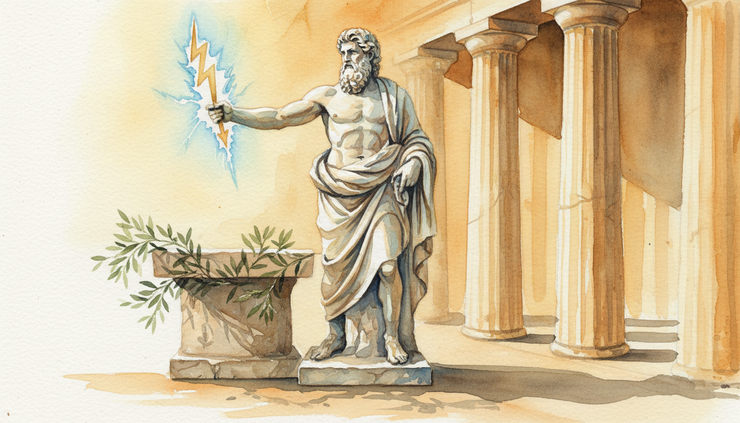
The thunderbolt is Zeus’s most famous attribute, but it carries several layers of meaning.
It represents:
Divine judgment
Zeus strikes when boundaries are violated or arrogance becomes dangerous.
Clear command
Lightning does not negotiate. It reveals, splits, and acts.
Storm and fertility
Rain follows thunder. Zeus can be fierce, but he also nourishes the land.
Sudden revelation
Lightning briefly illuminates what was hidden.
In modern spiritual language, the thunderbolt can symbolize a moment of truth. It cuts through confusion and demands accountability.
Key stories show Zeus as ruler, protector, lover, and lawgiver
Zeus appears in a vast number of myths, and not all of them present him in a flattering way. Ancient myth did not always expect gods to behave like moral ideals. Instead, the gods often dramatized forces of nature, power, desire, fear, and social order.
Zeus and Prometheus
Prometheus steals fire and gives it to humanity. Zeus punishes him by chaining him to a rock, where an eagle comes each day to eat his liver, which grows back overnight.
This myth raises hard questions. Is Zeus cruel, or is he defending cosmic limits? Is Prometheus a rebel, a benefactor, or both? Many modern readers sympathize with Prometheus, but Zeus’s role still reflects an ancient concern: divine gifts carry consequences, and power must be handled with care.
Zeus and xenia
One of Zeus’s most important moral roles is protector of `xenia`, the sacred bond between guest and host. In ancient Greek culture, hospitality was not casual politeness. It was a holy duty.
The story of Baucis and Philemon shows this side of Zeus. Zeus and Hermes, disguised as travelers, seek hospitality and are rejected by many. An elderly couple welcomes them with humility and generosity. The gods reward them, while the inhospitable community faces punishment.
Here, Zeus is not just king of heaven. He is the guardian of strangers, travelers, and ethical conduct.
Zeus in the Trojan War
In the Iliad, Zeus stands above the battlefield, holding the scales of fate. He does not simply control everything. Fate, honor, oath breaking, divine politics, and human choices all matter.
This is one of the richest aspects of Zeus. He is powerful, but not always free to act without limits. That makes him a god of sovereignty inside a larger web of destiny.
The difficult myths of Zeus
Many myths describe Zeus’s pursuit of lovers through disguise, force, or deception. These stories need care in modern spiritual writing. They reflect ancient patriarchal cultures and mythic storytelling, not behavior to romanticize or excuse.
Modern devotees often approach Zeus through his roles as protector, oath keeper, storm bringer, father of gods, and guardian of justice rather than through myths of coercive sexuality. A mature practice can acknowledge the material without pretending every story is spiritually comfortable.
The attributes of Zeus reveal his many domains
Zeus is associated with the sky, storms, law, kingship, protection, and social bonds. His sacred signs and symbols help clarify how people understood him.
Common attributes include:
Attribute | Meaning |
Thunderbolt | Judgment, divine authority, sudden truth |
Eagle | Sovereignty, vision, height, kingship |
Oak tree | Endurance, sacred presence, prophecy |
Scepter | Rule, order, command |
Aegis | Protection, awe, divine force |
Rain clouds | Fertility, blessing, atmosphere, weather |
The oak was especially important at Dodona, one of the oldest Greek oracle sites. There, priests and priestesses interpreted divine messages through the rustling of oak leaves and other signs. This gives Zeus a listening, atmospheric quality. He is not only the god who speaks through thunder. He also murmurs through trees.
The epithets of Zeus show how people met him
Greek gods were worshipped through names that identified specific powers, places, and relationships. These names, called epithets, help us see Zeus not as one flat personality, but as a god with many faces.
Zeus Olympios
Zeus Olympios means Zeus of Olympus. This title emphasizes his role as ruler of the Olympian gods. It points to majesty, hierarchy, and divine kingship.
A practitioner might call on Zeus Olympios for leadership, dignity, and the strength to make difficult decisions.
Zeus Xenios
Zeus Xenios is Zeus as protector of guests, strangers, and hospitality. This epithet carries strong ethical weight.
He watches how people treat those who arrive at their door, especially those without power. In modern devotion, Zeus Xenios can be honored through generosity, respectful hosting, and care for travelers or displaced people.
Zeus Horkios
Zeus Horkios is guardian of oaths. This is one of his most serious forms.
To invoke Zeus Horkios is to bring sacred attention to promises, vows, contracts, and spoken truth. This epithet suits magical work around integrity, accountability, and keeping one’s word. It should not be used lightly.
Zeus Ktesios
Zeus Ktesios protects the household’s goods, stores, and prosperity. Ancient households honored him as a guardian of resources and family stability.
Modern practitioners can approach Zeus Ktesios for household protection, responsible abundance, and care for the home.
Zeus Herkeios
Zeus Herkeios is Zeus of the courtyard or boundary of the home. His shrine often stood in domestic space.
This epithet highlights protection, family continuity, and sacred boundaries. He is especially relevant for home blessing rituals and threshold magic.
Zeus Ombrios and Zeus Hyetios
These titles connect Zeus with rain. Zeus Ombrios and Zeus Hyetios both point to his weather-bringing power.
In places shaped by agriculture, rain meant survival. Today, these epithets can support work around renewal, emotional release, fertility of projects, and gratitude for the natural world.
Zeus Meilichios
Zeus Meilichios is a gentler, chthonic, and sometimes wealth-bringing form of Zeus. His name is often understood as “kindly” or “gracious.”
He was honored in rites connected with purification, ancestral concerns, and appeasement. For modern devotees, Zeus Meilichios can feel less like the thunderous king and more like a deep, solemn presence that receives offerings with gravity.
Modern devotion to Zeus is both ancient and evolving
Modern devotion to Zeus appears in Hellenic polytheism, eclectic paganism, devotional witchcraft, and personal spiritual practice. Some practitioners reconstruct ancient Greek customs as closely as possible. Others build respectful new practices inspired by myth, symbol, and lived experience.
Today, Zeus is often perceived as:
A god of authority without passivity
A protector of households and sacred boundaries
A force of justice, law, and oath keeping
A storm presence tied to awe and renewal
A challenging deity who asks for maturity
Modern devotion does not require ignoring the harder myths. It can include study, discernment, and honest boundaries. Many devotees focus on building a reciprocal relationship through regular offerings, prayer, ethical action, and attention to signs in nature.
Devotion to Zeus works best when power and responsibility are treated as inseparable.
That idea sits at the heart of his worship. Zeus is not only “big energy.” He is the question of what someone does once they have power.

Working with Zeus in modern witchcraft calls for respect and clarity
For modern witches, Zeus can be approached in spells and rituals related to protection, justice, leadership, weather symbolism, courage, truth, and sacred vows. His presence can feel expansive, bright, commanding, and sometimes stern.
A good starting point is to decide which aspect of Zeus you are addressing. Zeus Xenios, Zeus Horkios, and Zeus Ktesios do not carry the same ritual tone.
Before working with him, ask:
What am I asking for?
Which epithet fits this work?
Am I prepared to act with integrity after the ritual?
Does this spell respect the free will and dignity of others?
What offering will I give in return?
Zeus is not usually approached for petty domination or impulsive revenge. His current is better suited to justice, protection, lawful resolution, moral courage, and clear authority.
Offerings for Zeus
Traditional and historically inspired offerings may include:
Clean water
Wine, if appropriate for your practice
Olive oil
Honey
Barley
Incense such as frankincense
Oak leaves or acorns gathered respectfully
Lightning imagery
A candle in white, gold, or deep blue
Practical offerings also matter. For Zeus Xenios, acts of hospitality can be devotional. For Zeus Horkios, keeping a promise may be the strongest offering. For Zeus Ktesios, caring for the home and avoiding waste can become sacred action.
If you leave offerings outdoors, choose items that are safe for local wildlife and the environment.
A simple altar for Zeus
A Zeus altar does not need to be elaborate. A small, clean space can hold:
A candle
A bowl for offerings
An image or symbol of an eagle, oak, or thunderbolt
A stone from a high place, gathered legally and respectfully
A written prayer or hymn
A small jar for household blessing work
Place the altar where it feels elevated, clean, and stable. Zeus’s energy often suits order rather than clutter.
Rituals and practices that honor Zeus
These rituals can be adapted for solitary practice. Keep fire safety in mind, and never perform outdoor rituals during dangerous storms.
A thunderbolt clarity ritual
Use this when you need truth, direction, or courage to make a decision.
You will need:
One white or gold candle
A small bowl of water
A pinch of salt
Paper and pen
Light the candle. Add the salt to the water and say:
“Zeus of the clear sky and sudden light, let falsehood fall away. Let me see what must be seen.”
Write the situation on paper. Beneath it, write three truths you already know but may be avoiding. Sit quietly for several minutes. Watch the candle flame. Do not force an answer. Let the practice sharpen what is already present.
When done, pour the water at the base of a tree or into the earth if safe and appropriate.
A household protection rite with Zeus Herkeios
This rite honors Zeus as guardian of the home boundary.
Walk the edge of your living space with a bowl of clean water. If you live in an apartment, walk the inner boundary of your rooms.
At each doorway or window, touch a little water to the frame and say:
“Zeus Herkeios, guard this boundary. Let this home be steady, honest, and protected.”
End at the center of the home. Offer a small amount of olive oil or incense and give thanks.
A vow practice with Zeus Horkios
This is best for serious commitments. Do not use it for goals you are not ready to keep.
Write your vow in plain language. Avoid dramatic phrasing. Say exactly what you intend to do.
Light a candle and read the vow aloud. Then say:
“Zeus Horkios, witness my words. May I keep faith with what I have spoken.”
Place the written vow somewhere private. Revisit it on a set schedule. The magic here is not only the spoken vow, but the discipline that follows.
A rain meditation with Zeus Ombrios
This practice works well during gentle rain, or with recorded rain sounds if weather does not allow.
Sit near a window. Breathe slowly. Imagine the sky opening, not in anger, but in release. With each inhale, receive steadiness. With each exhale, let tension drain away.
Reflect on this question:
What in my life needs rain before it can grow?
Offer water afterward. Keep the practice simple and sincere.

Signs, discernment, and healthy boundaries
People often associate Zeus with storms, eagles, sudden insight, legal matters, fatherhood themes, leadership tests, and strong dreams. These can feel meaningful, but discernment matters.
Not every thunderstorm is a message. Not every eagle image is a divine sign. A grounded practice leaves room for both wonder and common sense.
Healthy devotion includes:
Study myth from more than one source
Keep a journal of prayers, offerings, dreams, and results
Avoid making major life choices based only on signs
Respect cultural history without claiming perfect ancient authority
Set personal boundaries around myths or themes that feel harmful
Working with Zeus should not make life smaller or more fearful. At its best, it builds courage, honesty, and a stronger relationship with responsibility.
Zeus still matters because power still matters
Zeus remains compelling because his myths ask questions that have not gone away. Who gets to rule? What makes power legitimate? What do oaths mean? How should strangers be treated? When does justice strike, and when should mercy lead?
For mythology lovers, Zeus offers a rich and sometimes difficult portrait of divine kingship. For spiritual practitioners, he can become a profound ally in work that calls for clarity, protection, leadership, and moral strength.
Approach him with respect. Choose the epithet that fits your purpose. Offer cleanly. Speak honestly. Then follow your ritual with action that matches your words.
That is where devotion to Zeus becomes more than admiration for a god of thunder. It becomes a practice of standing straighter beneath the open sky.


Comments