Deity of the Week: Athena

Athena does not enter Greek myth quietly. She bursts from the head of Zeus fully armed, crowned with intelligence, strategy, and a kind of fierce calm that never leaves her. Among the Olympians, she stands out because her power is not raw force alone. It is judgment, skill, timing, and discipline.
To ancient Greeks, Athena protected cities, guided heroes, inspired artisans, and shaped the ideals of wise leadership. To many modern practitioners, she remains a living presence of courage, study, craft, and clear vision.
This guide explores Athena’s mythology, her most meaningful epithets, her role in ancient Greek culture, and practical ways to honor her in contemporary witchcraft and daily life.
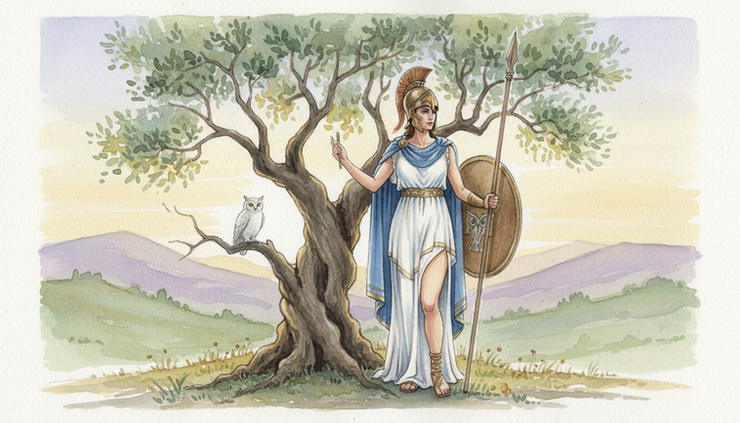
Athena’s origins reveal a goddess of mind and might
Athena’s birth story tells us almost everything about her nature.
In one major tradition, Zeus swallows Metis, a goddess of wisdom and cunning, after hearing that her child might become greater than he is. Later, Zeus suffers a terrible headache. His head is split open, and Athena emerges fully grown, armored, and ready for battle.
This myth is dramatic, but it is more than spectacle. Athena comes from Metis, a name tied to practical intelligence, craft, and strategy. She is born from Zeus, king of the gods, but carries the wisdom of a goddess who knew how to think ahead.
That combination matters. Athena is not a war goddess in the same way Ares is. Ares represents bloodshed, chaos, and the frenzy of battle. Athena represents tactics, defense, restraint, and victory through skill. She fights when needed, but she prefers the well-made plan.
Her myths often show her guiding people through complex situations:
She helps Odysseus survive not through brute strength, but through disguise, patience, and clever timing.
She aids Perseus by giving guidance in his quest against Medusa.
She supports heroes who listen, learn, and act with discipline.
She punishes arrogance when skill becomes pride without reverence.
Athena’s wisdom is not passive. It is active, practical, and tested in the world.
Athena’s epithets show her many faces
Greek gods were rarely known by one name alone. Epithets described their powers, local roles, places of worship, and ritual identities. Athena’s epithets reveal how deeply she lived in the Greek imagination.
Epithet | Meaning and significance |
Pallas Athena | One of her most familiar names. The origin is debated, but it often appears as a heroic and martial title. |
Athena Parthenos | Athena the Virgin, honored in the Parthenon at Athens. This title speaks to her independence and sacred self-possession. |
Athena Polias | Athena of the City, protector of the polis and civic order. |
Athena Promachos | Athena who fights in front, a guardian force in battle and defense. |
Athena Ergane | Athena the Worker, patron of crafts, weaving, and skilled labor. |
Athena Nike | Athena of Victory, linked with success earned through strategy and divine favor. |
Glaukopis Athena | Often translated as gray-eyed, bright-eyed, or owl-eyed Athena. The word suggests sharp sight and piercing awareness. |
Tritogeneia | A mysterious ancient epithet, possibly linked to birth, place, or water. Its exact meaning remains debated. |
These names are not decorative. Each one opens a doorway into a different relationship with the goddess.
Athena Polias belongs to temples, city walls, law, and protection. Athena Ergane belongs to the loom, the workshop, the writer’s desk, the artist’s hands. Athena Promachos belongs to courage under pressure. Glaukopis Athena belongs to clear seeing, especially when truth hides behind fear or confusion.
To study Athena’s epithets is to see why she could matter to soldiers, rulers, poets, potters, weavers, philosophers, and householders at once.
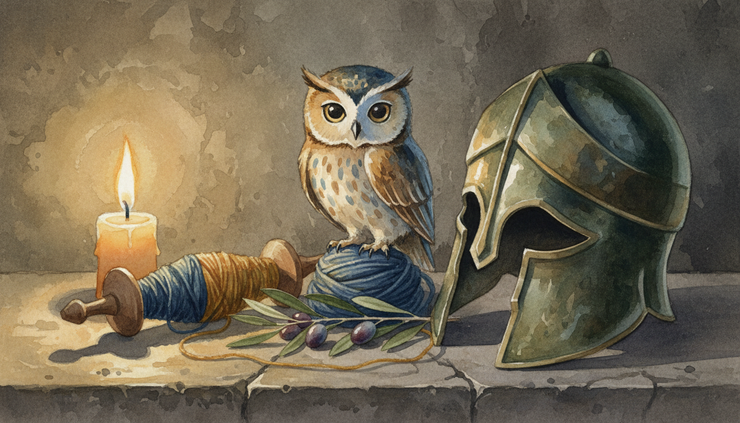
Athena shaped ancient Greek culture in lasting ways
Athena was central to the identity of Athens, one of the most influential cities of the ancient Greek world. The city’s name itself reflects her importance.
One famous myth tells of a contest between Athena and Poseidon for patronage of the city. Poseidon strikes the ground and brings forth a spring or horse, depending on the version. Athena offers the olive tree. The people choose her gift because it provides food, oil, wood, and long-term prosperity.
The story captures Athena’s character. She offers something useful, cultivated, and enduring.
The olive tree became one of her strongest symbols. It suggests peace, wealth, nourishment, and the patience of civilization. A spear wins a battle, but an olive tree sustains a people.
Athena was also honored through major festivals, especially the Panathenaia in Athens. This festival included processions, offerings, athletic contests, and the presentation of a woven garment to the goddess. That detail matters because it connects public worship with craft. The city did not only praise Athena through speeches and sacrifices. It honored her through skilled hands.
She also governed the moral use of talent. The myth of Arachne is a stark example. Arachne is a brilliant weaver who challenges Athena and fails to show reverence. Versions differ in tone and detail, but the story warns against pride that loses respect for divine order, teachers, and the sacred nature of skill.
Athena’s cultural importance rests on three pillars:
Wisdom
She represents knowledge applied with judgment. This includes planning, counsel, law, and strategic thought.
Warfare
She governs disciplined conflict, defense, and just action. Her battlefield is guided by purpose, not rage.
Crafts
She patronizes weaving, spinning, metalwork, and skilled making. Her wisdom lives in the hand as much as in the mind.
This blend makes her unusually complete. Athena teaches that intelligence must become action, and action must be shaped by care.
Her symbols carry practical meaning
Athena’s symbols are easy to recognize, but they are richer when read as spiritual tools.
The owl stands for sight in darkness. It suggests the ability to notice what others miss. This is not only intellectual wisdom. It is intuition trained by attention.
The olive tree points to peace, endurance, and useful abundance. It reminds practitioners that protection is not only a shield. Sometimes protection is food, shelter, friendship, and long-term planning.
The aegis, a protective shield or cloak often linked with the head of Medusa, represents divine defense and awe. Athena’s protection can be fierce. It can also ask for boundaries.
The spear and helmet signify readiness. Athena does not seek needless conflict, but she does not meet danger unprepared.
The loom and spindle belong to Athena Ergane. They honor patience, pattern, repetition, and mastery. A woven cloth becomes a perfect image of wisdom: many small threads brought into order.
For modern devotion, these symbols can become altar items, meditation anchors, journal themes, or ritual tools.

Modern devotion to Athena in contemporary witchcraft
Modern devotion to Athena varies widely. Some practitioners approach her through Hellenic polytheism with careful attention to ancient sources. Others honor her within eclectic witchcraft, devotional paganism, or personal spiritual practice.
Both paths can be meaningful when they are grounded in respect.
Ancient Greek religion was public, local, and communal. Modern practice is often private and personal. That means modern devotees usually do not recreate ancient worship exactly. Instead, they draw from myth, symbolism, historical knowledge, and lived spiritual experience.
Common offerings to Athena include:
Olive oil
Olives or bread
Clean water
Incense such as frankincense
Handwritten hymns or prayers
Weaving, embroidery, drawing, or other crafted work
Study time dedicated in her honor
Acts of justice, protection, or mentorship
For practitioners of witchcraft, Athena’s energy often connects with spells and rituals for:
Clear thinking
Protection
Courage
Skill-building
Academic success
Legal fairness
Strategic decision-making
Creative discipline
Boundary setting
A simple ritual can be enough. Athena’s presence does not require excess. She asks for sincerity, effort, and clarity.
A simple Athena ritual for wisdom and courage
Choose a quiet space. Place a candle, a bowl of water, and one symbol of Athena on a clean surface. This could be an olive branch, an owl image, a notebook, a woven cloth, or a small tool related to your craft.
Light the candle and say:
Athena, clear-eyed one, guide my mind, steady my hands, and teach me to act with wisdom.
Sit for a few minutes. Think of one situation where you need better judgment. Do not ask only for an easy answer. Ask for the discipline to see clearly.
Write down three things:
What is true right now
What fear may be distorting
What wise action comes next
When finished, thank Athena. Pour the water outside or into a plant if safe. Then take one practical step within 24 hours. Send the message, study the material, repair the tool, make the plan, or set the boundary.
The ritual works best when paired with action. Athena favors practice.
How to connect with Athena’s energy in daily life
Devotion does not have to stay at the altar. Athena’s teachings fit naturally into ordinary routines.
Practice strategic reflection
Before making a difficult choice, pause and ask:
What outcome am I protecting?
What information do I still need?
What response serves wisdom rather than pride?
Where would patience help more than force?
This kind of questioning is deeply Athenian. It turns reaction into discernment.
Build one skill with devotion
Athena Ergane honors craft, not perfection. Choose one skill and practice it regularly. It might be sewing, writing, pottery, coding, gardening, cooking, language study, or music.
Dedicate the first few minutes to Athena. Keep the work honest. Track progress. Let repetition become prayer.
Keep an owl-eyed journal
Use a notebook for clear seeing. At the end of the day, write one short entry about what you noticed.
Try prompts such as:
I saw the truth more clearly when...
I acted from wisdom when...
I confused pride with strength when...
Tomorrow I can choose better by...
This practice connects with Glaukopis Athena, the bright-eyed goddess who notices what hides in shadow.
Protect what is worth protecting
Athena’s warrior aspect is not about constant battle. It is about defense with purpose.
Protection can look like locking a door, speaking honestly, voting, helping a neighbor, preserving time for study, or refusing to feed needless conflict. Athena Promachos teaches that courage should have direction.
Honor wisdom through service
Athena’s wisdom was civic. She belonged to the city as well as the shrine. Modern devotion can include tutoring, sharing skills, supporting libraries, helping with community gardens, or standing up for fair treatment.
A devotional act does not need to announce itself as spiritual to be sacred.

Respecting Athena means respecting complexity
Athena is often called a goddess of wisdom, but her wisdom is not always soft. She can be demanding. In myth, she rewards discipline, loyalty, courage, and skill. She also challenges vanity, rashness, and refusal to learn.
That complexity makes her powerful for modern practitioners. She does not simply comfort. She sharpens.
For history lovers, Athena reveals ancient Greek ideals around civic order, excellence, reason, and divine protection. For witches and devotional practitioners, she offers a path of clear thought, sacred craft, and brave action.
One helpful way to approach Athena Unveiled Mythology Epithets and Modern Devotion is to treat her many names as teaching tools. Call on Athena Polias when thinking about home, community, and protection. Call on Athena Ergane when developing a skill. Call on Athena Promachos when courage must be disciplined. Call on Glaukopis Athena when the truth needs a sharper eye.
The heart of Athena’s practice is simple: learn carefully, act wisely, make skillfully, and protect what matters.
Light the candle if you wish. Offer olive oil if it feels right. Read the myths, study the epithets, and listen for the quiet command beneath them all.
Then do the work.



Comments