Deity of the Week: Selene

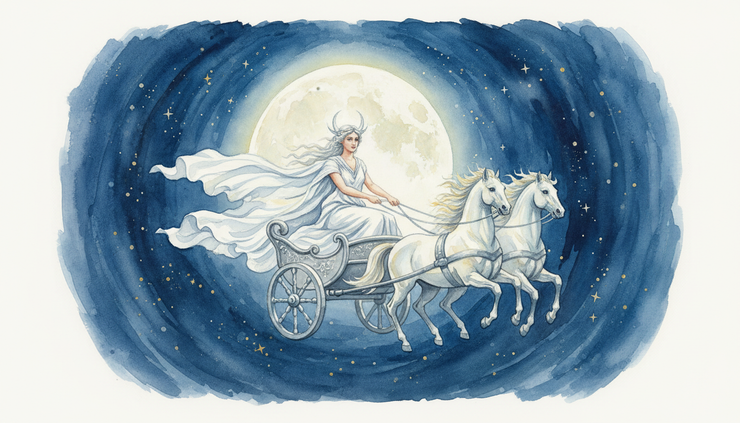
Selene is one of the most literal deities in Greek myth: she is the Moon, not only a goddess associated with it. When ancient poets described silver light spilling across the night, they often imagined Selene herself crossing the heavens in a shining chariot.
Her mythology is graceful, but not simple. She belongs to the older Titan generation, shines beside gods like Helios and Eos, loves the sleeping shepherd Endymion, and carries names that reveal how ancient people understood moonlight, time, beauty, and divine presence.
Today, Selene remains a powerful figure in modern witchcraft and devotional practice. Her image appears in full moon rituals, dreamwork, lunar altars, meditation, and quiet nightly offerings. To connect with her is to build a relationship with rhythm, reflection, and the changing face of light.
Selene was the Moon made divine
In Greek mythology, Selene is usually named as the daughter of the Titans Hyperion and Theia. Her siblings are Helios, the Sun, and Eos, the Dawn. Together they form a radiant family of sky powers who mark the passage of day and night.
Selene’s role is clear and cosmic. Helios rises in the morning and drives the sun across the sky. Eos opens the gates of dawn. Selene appears at night, carrying the Moon’s light over the sleeping world.
Ancient writers often pictured her in a chariot drawn by horses. Some traditions give her two horses, others describe oxen or bulls, animals that connect her to fertility, strength, and the crescent shape of horns. She is often shown with a crescent moon on her head, a veil billowing behind her, and a torch or shining aura around her body.
Unlike Artemis, who became strongly linked with the Moon over time, Selene is not primarily a huntress. Unlike Hecate, who rules crossroads, spirits, and liminal magic, Selene is the visible Moon itself. The three goddesses sometimes overlap in later religion and magical thought, but each has her own center of gravity.
Selene’s mythology preserves an older way of seeing the sky. The Moon was not a distant rock or symbol. It was a living divine presence, reliable yet mysterious, familiar yet unreachable.
Selene’s epithets reveal her many faces
Greek gods were often honored through epithets, names or titles that described their powers, appearance, lineage, or local forms of worship. Selene’s epithets help us understand how worshippers and poets experienced her.
These titles were not random decoration. An epithet could shape the mood of a prayer. Calling on Selene as “bright” feels different from calling on her as “Titan-born.” One name asks for light. Another honors ancient power.
Epithet or name | Meaning and significance |
Mene | Means “Moon” or “month.” This name links Selene to lunar time, calendars, cycles, and measurement. |
Phoebe | Means “bright,” “pure,” or “radiant.” It highlights Selene’s shining beauty and clear lunar glow. |
Titanis | Means “Titaness.” This title honors her ancient divine lineage as the daughter of Hyperion and Theia. |
Pandeia or Pandia | Often understood as “all-bright” or “all-shining.” In myth, Pandia is also named as a daughter of Selene and Zeus. |
Aegle | Associated with radiance, gleam, or splendor. This title points to the visible brilliance of moonlight. |
Leukippe or related white-horse imagery | Connected with whiteness and horses in some poetic associations. It reflects the pale animals that draw her chariot. |
Luna | Her Roman counterpart. While not a Greek epithet, Luna carried Selene’s identity into Roman religion and later magical language. |
Mene may be one of the most revealing names. The Greek word connects the Moon to the month, because lunar phases helped ancient people track time. Before printed calendars and digital reminders, the Moon was one of the most obvious clocks in the world.
Phoebe places emphasis on purity of light. It does not mean weak or soft. Moonlight can expose, guide, enchant, and unsettle. Under this name, Selene is luminous clarity in darkness.
Titanis reminds us that Selene is older than the Olympian order. She is not defined by Zeus, Apollo, or Artemis, even when later stories connect them. Her power belongs to the deep structure of the cosmos.
Pandeia and Aegle speak to splendor. These names suit full moon devotion, when Selene appears whole and bright. They are useful in ritual language when the intention is illumination, blessing, visibility, or gratitude.

The myth of Selene and Endymion still shapes her image
The best-known myth of Selene is her love for Endymion. He is usually described as a beautiful shepherd, hunter, or king, depending on the source. Selene sees him sleeping and falls in love. In many versions, Endymion is granted eternal sleep, keeping his youth and beauty forever.
The story has been retold in many ways. Some versions make Zeus responsible for the gift. Some suggest Endymion chose sleep himself. Others focus on Selene’s nightly visits to him.
Modern readers often notice the uncomfortable parts of this myth. A sleeping beloved raises questions about consent and desire, and it is fair to approach the story with care. Ancient mythology often preserves beauty and danger in the same image.
Symbolically, the myth says much about the Moon. Selene visits the sleeper, just as moonlight touches the sleeping world. Endymion remains still while she moves across the sky. Their relationship mirrors night itself: longing, distance, silence, recurrence.
The myth also ties Selene to dreams. She does not only illuminate roads and fields. She enters the private world of sleep, memory, and imagination. For this reason, modern devotees often approach her for dream recall, intuitive reflection, and inner vision.
Selene mattered to ancient cultures because the Moon mattered
Selene’s worship in ancient Greece was not as widespread or formally organized as the cults of Athena, Demeter, Artemis, or Apollo. Even so, her presence was everywhere because the Moon was everywhere.
Ancient life depended on sky rhythms. Lunar phases helped mark months, religious observances, agricultural timing, travel, and night work. The Moon affected when people could move safely after dark, gather socially, hold ceremonies, or watch over animals and land.
In Greek thought, the Moon also stood between worlds. It belonged to the heavens, but it changed constantly. It vanished, returned, grew, and diminished. That made it a natural symbol for cycles of loss and renewal.
Selene appears in poetry, hymns, vase painting, magical texts, and philosophical reflection. The Homeric Hymn to Selene praises her radiance, her long wings or shining path, and the beauty she brings to the night. Later writers link her with astrology, fate, and the influence of celestial bodies.
In Roman culture, Luna absorbed much of Selene’s character. Luna had temples and public recognition, including associations with the Aventine Hill in Rome. Over time, Greek Selene, Roman Luna, Artemis, Diana, and Hecate became intertwined in art, literature, and esoteric traditions.
That blending still affects modern practice. Many witches honor lunar divinity through a triple form: maiden, mother, and crone, or Artemis, Selene, and Hecate. This pattern is modern in the form many people use today, but it draws from real ancient overlaps among moon goddesses, night goddesses, and liminal powers.
Modern witchcraft keeps Selene’s light alive
Modern devotion to Selene often centers on direct relationship rather than formal reconstruction. Some practitioners study Greek sources and use historically inspired offerings. Others approach her through modern witchcraft, astrology, lunar magic, or personal devotion.
Both paths can be meaningful when practiced with respect.
For many witches, Selene represents:
Lunar cycles
Waxing, full, waning, and dark moon phases each carry different ritual moods.
Dreams and intuition
Her link to night makes her a natural presence in dreamwork and meditation.
Beauty and radiance
Selene’s light can support confidence, self-recognition, and sacred adornment.
Emotional reflection
The Moon’s changing face offers a gentle mirror for changing inner states.
Devotional consistency
Monthly rites help build spiritual rhythm over time.
A Selene altar does not need to be elaborate. Silver-colored objects, white candles, moonstone, selenite, clear quartz, bowls of water, white roses, jasmine, honey, milk, or written hymns all fit her symbolism. If using crystals, treat them as symbolic tools rather than guaranteed sources of results.
Offerings can stay simple:
Fresh water left under moonlight
A candle lit during prayer
Incense with a soft scent, such as jasmine or sandalwood
A handwritten poem or hymn
Quiet time spent watching the Moon
Milk, honey, or white flowers placed respectfully
The strongest offering is often attention. Selene is a goddess of return. Coming back to her at each moon phase can become its own devotion.

Rituals can help build a relationship with Selene
Selene’s rituals are especially suited to evening, full moon nights, and moments when her light is visible. If the sky is cloudy, the ritual still works as an act of devotion. The Moon does not stop existing when hidden.
A simple full moon ritual for Selene
This ritual focuses on gratitude, clarity, and connection.
Gather:
One white or silver candle
A bowl of clean water
A small offering, such as honey, milk, flowers, or incense
A journal
A place where the Moon is visible, if possible
Begin by washing your hands. This small act marks the shift from ordinary time into sacred time.
Light the candle and say:
Selene, bright Titaness, rider of the night sky, I welcome your silver light.
Place the bowl of water where it can catch moonlight. Look at the Moon, or imagine it clearly above you. Breathe slowly.
Name three things you are ready to see more clearly. They can be emotions, decisions, patterns, or hopes. Write them down.
Next, name one thing you are grateful for from the last lunar cycle. Offer the flower, honey, milk, or incense with a few sincere words.
Close with:
Selene Phoebe, radiant one, thank you for your light. May I walk with steadiness through change.
Let the candle burn safely for a short time, then extinguish it. Pour the water at the base of a plant, into the earth, or keep it briefly for symbolic cleansing.
A dream meditation with Selene
This practice works well before sleep.
Sit or lie down comfortably. Picture Selene’s chariot moving slowly across the sky. Her light does not force anything open. It reveals gently.
Breathe in for four counts. Breathe out for six. Imagine silver light resting on your forehead, then your throat, then your heart.
Ask one clear question. Keep it simple.
Good examples include:
What am I ready to understand?
What should I release this lunar cycle?
What dream wants my attention?
Where do I need more softness?
Keep a journal nearby. If you wake with a dream, phrase, image, or feeling, write it down before analyzing it. Over time, patterns may appear.
A waxing moon practice for growth
During the waxing moon, Selene’s light increases. This phase suits beginnings, confidence, study, and creative work.
Write one intention on paper. Place it under a bowl of water or beneath a white candle holder. Each night, speak one sentence of commitment.
For example:
As Selene grows bright, I give steady care to this work.
Take one small action the next day. Lunar magic becomes stronger when paired with lived effort.
A waning moon practice for release
During the waning moon, focus on clearing and letting go.
Write what you want to release on a small piece of paper. Read it aloud under the night sky. Tear the paper into small pieces and dispose of it safely. Avoid burning paper unless you have a safe, ventilated place and local rules allow it.
Then wash your hands and say:
As Selene lessens, this burden loosens.
This kind of rite can be simple and still powerful. The point is not drama. The point is honest release.
Selene invites reflection rather than performance
A relationship with Selene does not require expensive tools, perfect timing, or advanced study. Her presence is visible to anyone who looks up.
Still, knowledge deepens devotion. Learning her epithets gives richer language to prayer. Reading her myths adds texture and caution. Understanding her place in ancient culture keeps modern practice rooted rather than vague.
Selene can be approached as Mene when tracking cycles, as Phoebe when seeking clarity, as Titanis when honoring ancient power, and as Pandeia when celebrating fullness and radiance. These names let devotion become more precise.
The phrase Selene the Moon Goddess Epithets Mythology and Modern Witchcraft Rituals may sound like a collection of separate topics, but they belong together. Her names, stories, ancient significance, and modern rites all point to the same truth: Selene is a goddess of luminous return.

Walking with Selene through the lunar month
To begin connecting with Selene, start small. Watch the Moon for one month. Notice when it appears, how it changes, and how its light affects the night around you.
Choose one epithet each week.
During the new or dark moon, honor Mene and reflect on time, beginnings, and hidden growth.
During the waxing moon, honor Aegle and invite brightness into your work.
During the full moon, honor Pandeia or Phoebe and celebrate clarity, beauty, and gratitude.
During the waning moon, honor Titanis and ask for the strength to release what has completed its cycle.
This practice turns devotion into observation. It also keeps witchcraft grounded in the real sky, not only in symbols.
Selene does not demand noise. Her myths are filled with silver movement, quiet longing, and steady return. Light a candle. Step outside. Speak one honest prayer. Let the Moon be both goddess and guide.



Comments