Deity of the Week: Hekate

Hekate stands at the threshold. In myth, she carries torches through the dark. In worship, she receives offerings at crossroads and doorways. In modern witchcraft, she is often approached as a guide through fear, grief, power, and change.
Her presence is not simple, and that is part of her pull. Hekate is lunar and chthonic, protective and unsettling, ancient and startlingly current. Her many epithets show a goddess who cannot be reduced to one role. She is a guardian, a key-bearer, a light-bringer, a spirit-worker, and a keeper of boundaries.
To understand Hekate is to follow the names people have used for her, then listen for what those names still mean in practice.
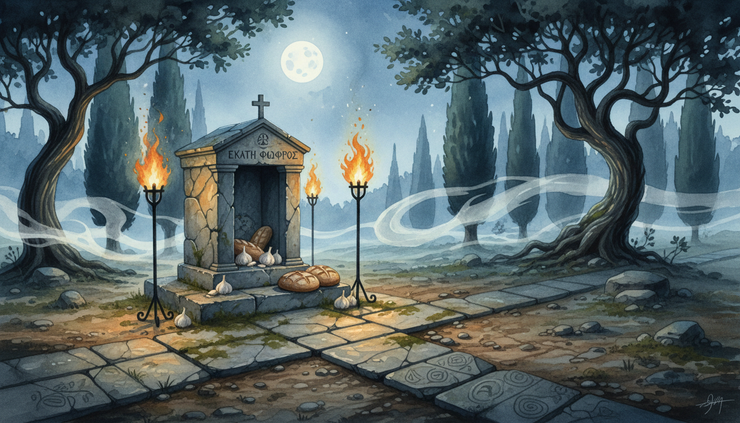
Hekate in myth is older and broader than one image
Many people first meet Hekate as a “goddess of witchcraft.” That title is true in a modern sense, but it is only one doorway into her mythology.
In Hesiod’s Theogony, Hekate is the daughter of the Titans Perses and Asteria. She receives honor from Zeus after the Olympians rise to power, which marks her as unusual. She is not cast aside with the old powers. She keeps influence over earth, sea, sky, kingship, victory, wealth, childbirth, and the raising of children.
This early portrait is expansive. Hekate is not only a night goddess. She is a goddess of reach.
In the Homeric Hymn to Demeter, she appears with torches after Persephone is taken to the underworld. Hekate hears the cry, helps Demeter search, and later becomes Persephone’s companion. This myth shapes one of her most enduring roles: the guide who goes where others hesitate to go.
Later sources connect her more strongly with spirits, necromancy, magic, crossroads, and the restless dead. In art, she may appear triple-formed, holding torches, keys, daggers, serpents, ropes, or bowls. Dogs are sacred to her, and their howling was often taken as a sign of her presence.
None of these images cancels the others. Hekate is many-sided because the places she governs are many-sided. A threshold is both an entrance and an exit. Night can hide danger, but it also reveals stars. A key can lock a door or open it.
Her epithets reveal a goddess of thresholds, power, and protection
Hekate’s epithets are not decorative titles. They are devotional maps. Each name points toward a quality, place, function, or relationship.
Some epithets come from ancient literature and inscriptions. Others grew through later magical and devotional traditions. Together, they show why Hekate remains so compelling to witches, polytheists, occultists, and spiritual seekers.
Hekate Enodia walks the road
Enodia means “of the road” or “in the road.” This title places Hekate on paths, especially where paths cross. Roads are practical and magical places. They carry travelers, news, trade, danger, and the dead.
As Enodia, Hekate is not distant. She is encountered while moving from one state to another. People call on her when they are between homes, between identities, between decisions, or between versions of themselves.
This epithet can be especially meaningful during life changes. A move, a divorce, a new spiritual path, recovery from loss, or the end of a long habit can all be Enodia moments.
Hekate Propylaia guards the gate
Propylaia means “before the gate.” This Hekate stands at the entrance. She protects the home, temple, city, and sacred boundary.
Modern devotees often connect this title with household protection. A small shrine near the front door, a key charm, or a monthly cleansing of the threshold can honor Hekate Propylaia.
This is not only about keeping harm away. It is also about choosing what may enter. Hekate Propylaia asks for discernment. What influences belong in the home? What habits need to stay outside?
Hekate Phosphoros brings light
Phosphoros means “light-bringer.” It is one of her most beautiful and useful titles. Hekate does not remove the dark. She carries light through it.
This matters. Her light is not denial, forced positivity, or escape. It is the torch held steady on the path ahead. For people working through shadow, grief, fear, or spiritual uncertainty, Phosphoros can be a name of comfort.
A practitioner might call on Hekate Phosphoros before journaling, therapy-supported reflection, ancestor work, or divination. Her torch helps reveal without rushing.
Hekate Chthonia belongs to the deep earth
Chthonia means “of the earth” or “under the earth.” This title links Hekate with the dead, the underworld, burial, roots, and hidden forces.
Chthonia is a powerful epithet, and it asks for respect. Working with this face of Hekate can involve ancestor veneration, graveyard etiquette, trance, spirit communication, or grief rituals. It is not a costume or a thrill.
Approach Hekate Chthonia slowly. Learn protection practices. Keep promises. Do not treat the dead as props. This title reminds practitioners that witchcraft has ethical weight.
Hekate Kleidouchos holds the keys
Kleidouchos means “key-bearer.” Keys are among Hekate’s clearest symbols. They speak of access, permission, secrecy, and responsibility.
A key-bearing goddess does not simply open everything on request. She teaches timing. Some doors remain closed for good reason. Some open only after preparation.
Modern witches often place old keys on Hekate’s altar. A key can represent a question, a boundary, a spiritual skill, or a path that needs blessing. It can also stand for consent, which is central to healthy magical practice.
Hekate Soteira saves and protects
Soteira means “savior” or “deliverer.” This title may surprise those who only know Hekate through spooky imagery. Yet many devotees experience her as fiercely protective.
Soteira is the goddess who helps a person leave danger, break a harmful pattern, or survive a passage that feels impossible. Her protection may feel tender, stern, or both.
Hekate Soteira is often invoked in spells for safety, courage, liberation, and spiritual protection. Her aid is rarely passive. She may open the exit, then expect the person to walk through it.
Hekate Trivia and Trioditis stand at the three ways
Trivia is the Roman title often linked with the crossroads. Trioditis means “of the three roads.” These names support her famous triple form.
The three-way crossroads can represent choice, past-present-future, birth-life-death, or the meeting of worlds. Modern practitioners may see it as a symbol of liminality, the charged space between clear categories.
This is why Hekate fits so naturally into contemporary witchcraft. Witchcraft itself often happens at the in-between: between seen and unseen, body and spirit, old wound and new action.

Modern devotion keeps ancient themes alive
Modern Hekate devotion is diverse. Some devotees are reconstructionist polytheists who focus on historical sources. Some are witches who work with her in spellcraft, spirit work, and protection. Some meet her through dreams, meditation, grief, or a pull they cannot explain.
There is no single required form of devotion. Still, common practices often echo ancient themes.
The Deipnon honors Hekate at the dark moon
One of the best-known practices is Hekate’s Deipnon, often observed around the dark moon. In ancient Greek household religion, offerings were left for Hekate and the restless dead, often at a crossroads or threshold.
Modern versions vary. Some people leave food offerings at an outdoor crossroads where it is safe and legal. Others place offerings at a home altar, then dispose of them respectfully. Some donate food or supplies to people in need as a devotional act, especially when leaving food outside would attract animals or create litter.
Common offerings include:
Garlic
Eggs
Bread or cakes
Honey
Wine
Olive oil
Fish
Onions
Incense
Keys
Black candles
Clean water
The heart of the practice is not extravagance. It is respect, regularity, and care.
Devotees build altars at thresholds
Hekate altars often include symbols of passage and protection. A compact altar may hold a candle, a key, a small dish for offerings, an image of Hekate, and herbs associated with protection or spirit work.
Doorway shrines are also common. A devotee may clean the front step, light incense, speak a short prayer, and ask Hekate Propylaia to guard the home.
This kind of practice fits modern life well. It can take five minutes, but it changes the feeling of a space. The doorway becomes conscious. Coming home becomes a small rite.
Rituals often focus on release and choice
Because Hekate stands at crossroads, many modern rituals with her focus on decision, release, and transition.
A simple ritual might look like this:
Clean the space and wash your hands.
Light a candle in a safe holder.
Place a key, a bowl of water, and a written petition on the altar.
Call Hekate by one or more epithets that fit the work.
Speak clearly about what needs to be released or opened.
Sit in silence and listen.
Give thanks and make an offering.
Take one grounded action within 24 hours.
That last step matters. Hekate’s magic often meets effort. If the ritual asks for courage, the next action should practice courage in real life.
Practitioner stories often share the same thread
Accounts of Hekate vary, but certain patterns appear often in devotional communities. These are personal experiences, not proof, yet they show how people relate to her today.
One common story comes from people who meet Hekate during a crisis. A practitioner may be grieving, ending a relationship, moving through spiritual doubt, or leaving a harmful situation. They begin seeing repeated symbols: keys, dogs, torches, crossroads, or the dark moon. Then they dream of a veiled woman, a flame, or a road splitting into three.
Another common account is less dramatic. Someone begins leaving a monthly offering at the dark moon. Over time, they feel more grounded at home. Their divination becomes clearer. Their boundaries improve. They stop saying yes when they mean no.
A witch in a community discussion once described Hekate’s presence as “a lamp at the edge of the woods.” That phrase captures what many feel. Hekate may not remove the forest, but she helps the path appear.
Another devotee described her as stern but fair: when they asked for help leaving a stagnant job, the answer came through uncomfortable clarity. They realized the “locked door” was not their workplace. It was their fear of being seen.
These stories share a theme: Hekate rarely arrives as decoration. She arrives at a turning point.

How to work with Hekate in contemporary witchcraft
Working with Hekate does not require a dramatic initiation or elaborate tools. It does require sincerity, patience, and respect for boundaries.
Begin with research and a clear intention
Start by reading myths and historical material alongside modern devotional writing. Learn the difference between ancient evidence, later occult tradition, and personal gnosis. All three can matter, but they are not the same thing.
Then get honest about why you feel drawn to her.
Are you seeking protection? Magical training? Shadow work? Ancestral connection? Help at a crossroads? The clearer the reason, the clearer the approach.
Choose the epithet that matches the work
Calling on a specific epithet can focus the ritual.
For example:
If the work involves | Call on |
Protection of the home | Hekate Propylaia |
Guidance through change | Hekate Enodia |
Clarity in shadow work | Hekate Phosphoros |
Ancestor or underworld work | Hekate Chthonia |
Opening or closing a path | Hekate Kleidouchos |
Safety and deliverance | Hekate Soteira |
Using an epithet shows care. It says, “I understand the face of the goddess I am approaching.”
Build a steady devotional rhythm
A small regular practice often matters more than one elaborate ritual.
Try a simple monthly devotion at the dark moon:
Clean your altar or threshold.
Light a candle.
Offer water, incense, or food.
Speak one of her names.
Thank her for guidance and protection.
Record dreams, signs, or insights in a journal.
If you promise an offering, follow through. If you cannot maintain a vow, do not make it. Hekate is strongly tied to oaths, thresholds, and consequence. Keep the practice honest.
Practice protection and grounding
Many people approach Hekate for spirit work, divination, or shadow work. These practices can be meaningful, but they need grounding.
Before ritual, set clear boundaries. Name who or what is welcome. Name what is not. After ritual, eat, drink water, touch the ground, or do a simple body-based practice.
If difficult emotions arise, treat them with care. Spiritual work can support healing, but it should not replace mental health care, medical support, or trusted community.
Watch for change in daily life
Hekate’s presence may show up in ritual, dreams, or signs. It may also show up as a practical demand.
A locked pattern becomes visible. A truth becomes harder to ignore. A boundary must be spoken. A path opens, but it requires the nerve to walk it.
This is where contemporary witchcraft becomes more than candles and symbols. The spell continues in choices, conversations, habits, and endings.
A simple devotional rite for Hekate
This rite is suitable for beginners and can be done at the dark moon, at night, or whenever you feel you are standing at a threshold.
You will need:
One candle, black, white, red, or any color you have
A key
A small bowl of water
A safe offering, such as bread, honey, garlic, or incense
A journal or piece of paper
Place the key beside the candle. Set the bowl of water nearby. Take three slow breaths.
Say:
Hekate Enodia, Hekate Propylaia, Hekate Phosphoros, Keeper of the road, guardian of the gate, bearer of the torch, Be present with me at this threshold. Guide what must open. Guard what must close. May I walk with wisdom, courage, and respect.
Sit quietly. Write down what you are ready to release, what you are ready to protect, and what you are ready to choose.
When finished, give thanks. Let the candle burn only as long as you can safely watch it. Dispose of offerings respectfully. If the offering is not safe for animals or the local environment, place it in the trash with gratitude or choose a charitable act instead.

Hekate invites respect, not fear
Hekate’s reputation can make her seem intimidating. She is a goddess of ghosts, crossroads, witchcraft, night, and the underworld. She is also a guardian of homes, a guide for the lost, a light-bearer, and a protector of those who stand between worlds.
Her epithets teach a balanced approach. Enodia reminds us to keep moving. Propylaia teaches boundaries. Phosphoros offers light without pretending the dark is harmless. Chthonia asks for reverence. Kleidouchos teaches patience with closed doors. Soteira shows that protection can be fierce.
To connect with Hekate, begin simply. Learn her names. Light a candle. Clean your threshold. Leave a respectful offering. Ask for guidance at a real crossroads in your life, then listen with honesty.
The old goddess of the three ways still meets people where the road divides. The work is to arrive with clean hands, a steady heart, and the courage to choose.


Comments