Deity of the Week: The Morrigan

The Morrigan is not a soft-focus goddess of vague “dark feminine” power. She is sharp, watchful, and demanding. In Irish mythology, she stands near the clash of battle, the turning of fate, the testing of kings, and the living bond between land and sovereignty.
That complexity is exactly why so many modern witches, polytheists, and spiritual practitioners feel drawn to her.
Working with The Morrigan in modern witchcraft calls for more than dramatic altar décor or raven imagery. It asks for study, courage, honesty, and respect for a goddess whose presence can be both protective and unsettling. She is a figure of war, prophecy, transformation, and rightful power. To approach her well, it helps to understand where she comes from and what she asks of those who honor her today.

The Morrigan’s place in Irish mythology
The Morrigan, often written as Morrígan, is one of the most compelling figures in medieval Irish literature. Her name is commonly translated as “Great Queen” or “Phantom Queen,” though scholars debate the exact meaning. That uncertainty fits her well. She resists simple definitions.
She appears in stories connected with the Tuatha Dé Danann, the supernatural people of Irish myth. She is especially known from the Ulster Cycle and mythological material such as the Táin Bó Cúailnge and the Second Battle of Mag Tuired. In these stories, she moves between worlds and roles. She can appear as a woman, a crow or raven, a prophetic voice, an instigator, a protector, and a terrifying presence on the edge of conflict.
One reason she feels so complex is that “The Morrigan” may refer to one goddess or to a group of closely related goddesses. Names associated with her include Badb, Macha, Nemain, and sometimes Anand or Anu, depending on the source. Modern practitioners often speak of her as a triple goddess, but it is worth being careful with that phrase. The medieval material does not always present a neat three-in-one structure. Her identities overlap, shift, and blur.
That does not make her less powerful. It makes her more historically interesting.
The Morrigan is not only a war goddess. She is a force that reveals what battle means: fear, courage, loss, strategy, death, protection, and the consequence of choices. She brings the hidden cost of power into the open.
She is a goddess of war, but not only violence
When people first hear that The Morrigan is connected with war, they often picture bloodshed and aggression. That is only part of the picture.
In Irish myth, battle is not just physical combat. It is a place where fate becomes visible. It reveals loyalty, character, fear, and honor. A battlefield is a threshold where life can change in a single breath.
The Morrigan’s presence in war can be understood in several ways:
Prophecy
She foretells death, victory, or defeat. Her words carry the weight of what is coming.
Battle frenzy
She can stir terror, confusion, and intensity. She is linked with the psychological force of conflict.
Protection of the land
War in myth often concerns cattle, territory, kingship, and the health of the land. The Morrigan stands close to those themes.
Testing the hero
Her encounters with heroes are rarely simple. She challenges pride, weakness, and refusal.
Her relationship with Cú Chulainn in the Táin Bó Cúailnge is one of the best-known examples. She approaches him, tests him, and later appears in different animal forms during combat. Their story does not reduce neatly to villain and hero. It shows The Morrigan as a challenger, a force of fate, and a being whose recognition has consequences.
For modern practitioners, this can shift the way “war goddess” is understood. Working with her does not have to mean seeking conflict. It may mean learning how to face conflict that already exists. It may mean developing discipline, protecting boundaries, resisting injustice, or accepting the truth of a difficult situation.
The Morrigan does not romanticize struggle. She teaches that power has a price.
Fate and prophecy are central to her power
The Morrigan’s connection to fate is one of her most important features. She does not simply predict the future like a fortune teller in a story. She announces turning points. She speaks at moments when choice and consequence meet.
In some myths, she appears before or after battle, proclaiming what has happened or what will happen. Her voice marks the movement of destiny. This gives her a liminal quality. She stands at thresholds:
Before battle and after battle
Before death and after death
Before a choice and after its cost becomes clear
Between human society and the Otherworld
This is one reason diviners, seers, and witches who practice shadow work may feel drawn to her. Her energy can cut through self-deception. She is not always comforting. She may not give the answer someone wants. Instead, her presence often presses a harder question: What truth are you avoiding?
For modern spiritual work, this does not mean every omen is a message from The Morrigan. Seeing a crow in a parking lot does not automatically mean she is calling. Crows and ravens are living beings with their own lives. Respect starts with discernment.
A useful approach is to track patterns over time. One striking dream may be meaningful, but repeated symbols, strong emotional clarity, mythic themes, ritual results, and grounded reflection matter more than a single coincidence.
A simple journaling practice can help:
Record dreams, omens, and ritual experiences.
Note your emotional state and real-life context.
Compare what appears repeatedly.
Study the myths alongside your experiences.
Wait before making major claims or commitments.
The Morrigan is often associated with intensity, but intensity alone is not proof of contact. A respectful path balances spiritual experience with study and common sense.
Sovereignty is one of her deepest mysteries
The Morrigan’s sovereignty aspect may be less famous than her warlike image, but it is essential.
In Irish tradition, sovereignty is not only rulership. It is the sacred relationship between land, people, justice, and rightful authority. A ruler’s legitimacy depends on more than force. The health of the land and the behavior of leadership are connected.
The Morrigan’s link to sovereignty appears in several ways. She is named as a queen. She interacts with kings and warriors. In some material, her union with the Dagda before battle is read as a sign of land, power, fertility, and victory aligning before conflict. She is not merely observing power. She is part of what makes power legitimate or doomed.
For modern practitioners, sovereignty can become a deeply personal theme. It may involve:
Keeping promises to oneself
Taking responsibility for one’s choices
Honoring the place where one lives
Refusing to give away personal authority
Acting with integrity when holding power over others
This is where The Morrigan’s work can become uncomfortable in the best possible way. She may call attention to where someone is ruled by fear, resentment, avoidance, or the need for approval. Her sovereignty is not about domination. It is about becoming answerable to truth.
A person who honors The Morrigan might ask:
Where am I abandoning my own authority, and where am I misusing it?
That question can become a ritual in itself.

How modern practitioners honor The Morrigan
Contemporary devotion to The Morrigan varies widely. Some people honor her as a deity within Irish polytheism. Others encounter her through witchcraft, devotional practice, trance, protection work, or personal spiritual experience. There is no single official modern method, but there are better and worse ways to approach her.
Strong practice usually begins with three things: study, consistency, and respect.
Study before devotion gets elaborate
Reading mythology matters. The Morrigan comes from Irish cultural and literary sources, not from a generic goddess archetype. Good practice includes learning about Irish myth, pronunciation, historical context, and the difference between medieval texts and modern interpretation.
This does not mean every practitioner must become a scholar. It does mean avoiding shallow claims. The more grounded the relationship, the less likely it is to drift into fantasy.
Helpful areas of study include:
The Táin Bó Cúailnge
The Second Battle of Mag Tuired
Irish sovereignty traditions
The roles of Badb, Macha, Nemain, and Anand
The place of crows and ravens in Celtic-language traditions
Modern Irish culture and respectful engagement with it
Build a simple altar or shrine
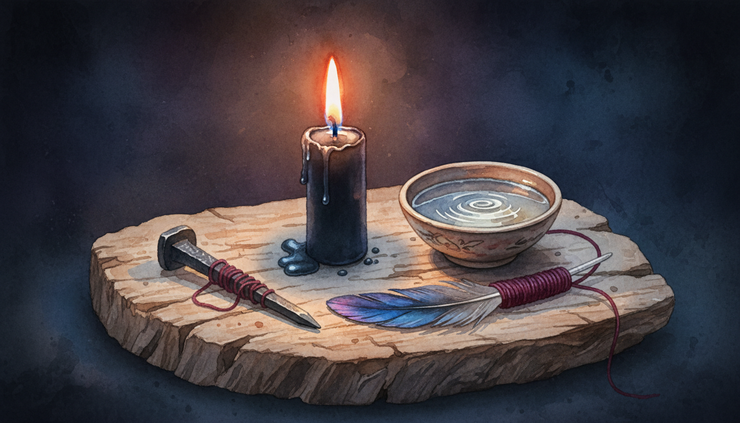
An altar for The Morrigan does not need to be dramatic. In fact, a restrained space may feel more appropriate than one crowded with symbols. Common items include:
A black, red, or white candle
A bowl of clean water
Iron objects, such as a nail or small blade kept safely
Images of crows, ravens, or battle standards
Stones from meaningful places, gathered legally and respectfully
Red thread or cloth
Written prayers, poems, or vows
Keep the space clean. If offerings spoil, remove them promptly. If using a blade, handle it safely and legally. The point is reverence, not danger.
Give offerings with intention
Offerings are a common way to honor The Morrigan. They should be thoughtful, ethical, and manageable. Better to offer something small with sincerity than to make a grand promise that cannot be kept.
Offerings may include:
Clean water
Dark bread or oats
Whiskey, mead, or beer, if appropriate for your practice
Blackberries or seasonal fruit
Incense or candle flame
Poetry, song, or spoken praise
Acts of courage
Volunteer work that protects people, animals, or land
Some devotees offer acts rather than objects. For a goddess tied to sovereignty and battle, this can be powerful. Keeping a hard promise, defending someone vulnerable, training in self-discipline, or cleaning litter from a local green space can become an offering when done with clear dedication.
Avoid offerings that cause harm. Blood offerings are not necessary and can be unsafe. Never harm animals or wildlife in the name of devotion.

Practical tips for working with The Morrigan in witchcraft
The Morrigan is not usually described by devotees as a casual presence. That does not mean newcomers should be afraid of her. It means the approach should be mature.
Start with clear intentions
Before calling on The Morrigan, know why. Are you seeking courage, protection, truth, discipline, or help facing a major transition? Vague curiosity can lead to vague results. Clear intention creates a stronger container.
A simple opening might be:
“Great Queen, Morrigan, if it is right and respectful, I ask to learn. May I see clearly, act bravely, and honor what is true.”
This kind of wording leaves room for consent, humility, and discernment.
Use protection and grounding
Her work can stir strong emotions. Ground before and after ritual. Eat something simple. Touch the floor. Step outside. Wash your hands in cool water. Record what happened, then return to ordinary life.
Spiritual intensity should not replace daily care. If a practice leaves someone constantly anxious, isolated, or unable to function, it is time to pause and seek grounded support.
Do not demand signs
Many practitioners make the mistake of asking powerful deities for proof on command. A better practice is to offer respect and pay attention without forcing meaning onto everything.
Ask for clarity, not spectacle.
Keep your vows realistic
The Morrigan is often associated with oaths, honor, and consequence. Do not promise daily rituals forever if you know you cannot keep them. A seven-day candle practice, a monthly offering, or a single act of service can carry more integrity than a dramatic vow made in an emotional moment.
Learn the difference between fear and reverence
Fear can be useful when it means respect for power. It becomes a problem when it turns into spiritual panic. The Morrigan’s fierce nature does not mean she is cruel for no reason. Many devotees describe her as demanding, protective, blunt, and transformative.
Reverence says, “This is powerful, and I will approach with care.”
Panic says, “Everything is a threat.”
Choose reverence.
A simple ritual to honor The Morrigan
This ritual is suitable for beginners and can be adapted by experienced practitioners.
You will need:
One candle, black, red, or white
A bowl of clean water
A small offering, such as oats, fruit, or a written prayer
A journal
Set the items on a clean surface. Take a few slow breaths. Light the candle safely.
Say:
“Morrigan, Great Queen, watcher of battle and fate, I come with respect. May this offering honor you. May I learn courage, truth, and right action.”
Place the offering beside the water. Sit quietly for several minutes. Do not strain for visions. Notice your body, thoughts, emotions, and the atmosphere of the room.
Ask one question:
“What truth do I need to face with courage?”
Listen. Write down anything that comes. When finished, thank her. Extinguish the candle. Dispose of the offering respectfully. If it is safe and appropriate, compost food offerings. Otherwise, wrap and discard them with care.
Walking with the Great Queen
The Morrigan’s mythology is rich because she refuses to be reduced. She is war, but not mindless violence. She is fate, but not helpless doom. She is sovereignty, but not ego. She stands where courage meets consequence.
For modern practitioners, her path can bring fierce clarity. It can teach protection, discipline, truthful speech, and devotion rooted in respect. The best way to begin is simple: read the myths, make a sincere offering, keep your word, and pay attention.
The Great Queen does not need performance. She asks for presence, courage, and the willingness to meet power with integrity.


Comments