Deity of the Week: Hephaestus

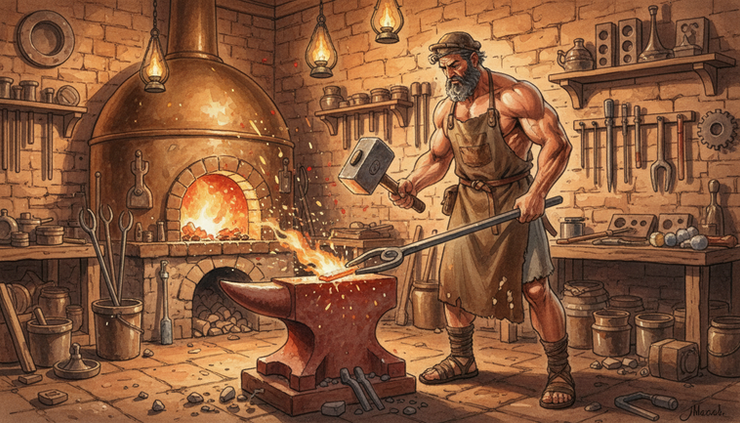
Fire can destroy a house, temper a blade, bake bread, warm a body, and turn raw ore into something useful. That mix of danger and care sits at the heart of Hephaestus, the Greek god of fire, metalwork, craft, invention, and sacred making.
He is not the flashiest Olympian. He does not rule the sea like Poseidon or hurl thunder like Zeus. Yet the gods live with his work all around them. Their palaces, thrones, weapons, jewelry, and wonders come from his hands. In myth, Hephaestus is the divine maker who understands heat, pressure, patience, and skill.
He also stands apart. Ancient stories often describe him as disabled, limping, or “crooked-footed.” Rather than making him lesser, those stories place him at the center of divine craft. Hephaestus turns exclusion into mastery. He makes beauty in the places others overlook.
The names and epithets of Hephaestus reveal his power
Greek gods often carry many names. These epithets act like small prayers. They point to roles, places, traits, and stories. For Hephaestus, they show both his craft and his complicated place among the Olympians.
Klytotekhnēs, often translated as “famous craftsman,” is one of his most fitting titles. It honors skill itself. Hephaestus is not only a god who owns a forge. He is known for excellence in making. The epithet praises knowledge gained through repeated work, burned fingers, close attention, and steady hands.
Klytos or Agaklytos, meaning “renowned” or “glorious,” appears in ancient poetry. These names remind us that his fame comes from what he creates. In a divine world full of beauty, his artistry still stands out.
Amphigyēeis is a more difficult epithet, commonly understood as “lame in both legs” or “crippled in both feet.” Modern readers may feel the sting in that language, and rightly so. Ancient texts did not share modern disability ethics. Still, Hephaestus offers a powerful figure for many disabled and chronically ill practitioners today because his body is not treated as separate from his sacred identity. His difference belongs to his mythic presence.
Chalkeus, meaning “bronze worker” or “smith,” connects him to metalcraft. Bronze mattered deeply in ancient Greek life. Weapons, vessels, armor, tools, and art all came through skilled metalworking. Calling Hephaestus Chalkeus honors his role as a divine smith.
Aithaloeis, often translated as “sooty” or “smoky,” brings him down from shining Olympus and places him in the workshop. This is not a clean, distant god. He is marked by labor. Soot on the skin becomes sacred.
Lemnios, “of Lemnos,” ties him to the island of Lemnos, one of his important cult centers. In myth, Lemnos becomes a place of landing, refuge, and worship. It links Hephaestus to real geography, not only divine imagination.
These epithets matter because they make Hephaestus more than “the fire god.” He is the god of skilled labor, survival after rejection, sacred utility, and the dignity of making.
Hephaestus in Greek mythology
The myths of Hephaestus often begin with fracture. Someone casts him out. Someone laughs. Someone underestimates him. Then he makes something no one else can make.
His birth and fall from Olympus
Ancient sources give more than one version of his birth. In Hesiod’s tradition, Hera bears Hephaestus without Zeus, sometimes as an answer to Zeus birthing Athena. In other accounts, he is the child of both Hera and Zeus.
His fall also varies. In one story, Hera throws him from Olympus because she is ashamed of his disability. He lands in the sea, where the goddesses Thetis and Eurynome shelter him. Hidden away, he learns craft and makes beautiful objects.
In another version, Zeus throws him from Olympus after Hephaestus defends Hera during a divine quarrel. He falls for a long time and lands on Lemnos, where the people care for him.
Both versions shape his character. Hephaestus is the one who survives the fall. He does not return empty-handed. He returns with art, skill, and power.
The golden throne and his return
One of his most memorable myths tells of a trap made for Hera. Hephaestus crafts a magnificent golden throne and sends it to his mother. When she sits, invisible bonds hold her fast. None of the gods can free her.
Ares tries force and fails. Dionysus succeeds through charm. He brings Hephaestus back to Olympus, usually described as drunk and riding a donkey or mule. The scene is strange, funny, and serious all at once.
The myth shows Hephaestus using craft as justice. His tools give him leverage in a world where brute power once cast him aside. He does not storm Olympus with an army. He builds an answer.

Aphrodite, Ares, and the unbreakable net
In the Odyssey, the bard Demodocus sings of Aphrodite and Ares. Aphrodite, married to Hephaestus in this version, takes Ares as a lover. Hephaestus discovers the affair and makes an invisible net so fine and strong that no one can escape it.
He catches the lovers in bed and calls the gods to witness. The scene mixes humiliation, comedy, and pain. For modern readers, it also shows Hephaestus as a maker of boundaries. His net reveals what others tried to hide.
The myth can feel harsh or awkward, especially through a modern lens. Still, it belongs to the larger pattern. Hephaestus sees clearly. He crafts a response. His intelligence lives in the object he makes.
The shield of Achilles and sacred craftsmanship
One of the most beautiful scenes in Greek literature comes in the Iliad, when Thetis asks Hephaestus to make armor for her son Achilles. He agrees because Thetis once cared for him after his fall.
The shield he creates is more than armor. It contains scenes of cities, fields, dancing, conflict, harvest, stars, and sea. It is a world in metal.
This myth reveals the deep spiritual meaning of craft. A made object can hold memory, protection, beauty, and fate. Hephaestus does not simply make equipment. He makes meaning take form.
Pandora, Prometheus, and divine invention
Hephaestus also appears in the myth of Pandora. At Zeus’s command, he shapes the first woman from earth and water. The gods give her gifts, and she becomes part of the punishment sent to humanity after Prometheus steals fire.
Hephaestus is sometimes involved in the punishment of Prometheus as well, binding him under Zeus’s order. These myths show a more complicated side of the god. Craft is not always gentle. Tools can heal, protect, deceive, or punish depending on who commands them and why.
That tension makes Hephaestus feel strikingly modern. Technology and skill are never neutral in practice. The maker must care about use, purpose, and consequence.
Ancient worship and sacred places
Hephaestus had important cult centers in the Greek world. Athens honored him alongside Athena, another deity of craft and skill. Their connection makes sense. Athena governs strategy, weaving, wisdom, and civic arts. Hephaestus governs fire, metal, tools, and embodied making.
The Temple of Hephaestus in Athens, one of the best-preserved ancient Greek temples, reflects his public importance. He was not only a mythic artisan hidden in a forge. He belonged to city life, labor, festivals, and civic identity.
On Lemnos, his worship carried local power. The island’s link to his fall and refuge made it one of the places most closely tied to him. Ancient sources also connect Hephaestus with volcanic and fiery places, though Greek myth does not reduce him to volcanoes alone.
A short ancient hymn to Hephaestus praises him as a god who works with Athena to teach glorious crafts to humanity. That pairing matters. Craft is civilization. To make tools, homes, vessels, and art is to shape human life.
Modern devotion to Hephaestus
Modern devotion to Hephaestus appears in Hellenic polytheism, pagan practice, reconstructionist ritual, eclectic spirituality, and private devotional life. Some devotees approach him through ancient hymns and offerings. Others meet him through craft, fire, repair, disability experience, or a lifelong relationship with tools.
A simple devotional practice might include:
Lighting a candle or oil lamp safely
Offering clean water, wine, bread, olives, or honey
Placing a small tool, nail, key, or handmade object on an altar
Reading a hymn to Hephaestus
Dedicating a repair, art project, or act of labor to him
Thanking him when a difficult task is finished
Fire safety belongs in his worship. A candle on a stable surface, a bowl of water nearby, and attention to pets, children, and fabric are not mundane details. They are part of honoring a fire god with care.
An altar to Hephaestus can be simple. A red or black cloth, a candle, a small hammer, a piece of iron, a handmade bowl, or a drawing of a flame can create a focus. Some people include images of donkeys, anvils, tongs, volcanoes, or bronze-colored objects.
Devotees often see him as a patron of craftspeople, welders, mechanics, jewelers, sculptors, potters, engineers, leatherworkers, glass artists, and repair workers. Others honor him while cooking, building, sewing, coding, or restoring broken household items.
“I feel closest to him when I fix something I almost threw away,” one practitioner shared in a public devotional discussion. “The prayer is in the patience.”
That sentence captures a common modern feeling. Hephaestus is present when frustration becomes focus.

Hephaestus in contemporary witchcraft
In contemporary witchcraft, Hephaestus often appears as a deity of transformation, craft magic, tool consecration, and protective fire. His presence fits naturally into witchcraft because so much magical practice depends on making. A charm is made. A candle is dressed. A sigil is drawn. A blade, cup, wand, or pentacle is chosen, cleaned, and charged.
Hephaestus can be called on for:
Candle magic
His fire is controlled fire. A candle spell for steady work, creative stamina, or protection can include a prayer to him. The focus is not wild flame, but tended flame.
Tool blessing
A practitioner might ask Hephaestus to bless a ritual knife, jewelry tool, sewing needle, cooking pot, or divination stand. The blessing can honor both the object and the hand that uses it.
Metal and talisman work
Keys, nails, rings, wire, coins, and small metal charms all suit his domain. A witch might craft a protective charm from iron or steel, then dedicate it to Hephaestus with smoke, heat, and spoken intent.
Repair magic
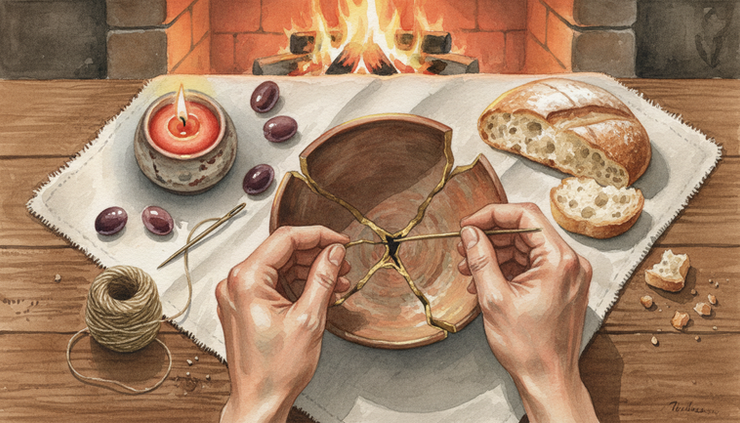
Mending can become spellwork. Stitching a torn bag, tightening a loose screw, or restoring a cracked bowl can carry the intention of healing patterns, rebuilding confidence, or strengthening a home.
Creative discipline
Hephaestus supports the less glamorous side of magic: practice, repetition, cleanup, patience, and skill. He is useful when inspiration fades and the work still needs doing.
It helps to approach him with respect rather than treating him as a vending machine for results. A good offering is sincere effort. Finish the project. Clean the tools. Learn the technique. Give thanks.
One witch described dedicating a month of craft practice to Hephaestus after years of abandoning projects halfway through. They chose one unfinished piece each week, lit a candle, said a short prayer, and worked for an hour without judging the result. By the end, the finished objects mattered less than the changed relationship with effort.
Another devotee, a disabled artist, has written in public pagan spaces about finding comfort in a god whose body is part of his story. For them, Hephaestus does not offer a fantasy of being “fixed.” He offers kinship with a sacred figure who creates from the body he has.
These stories show why Hephaestus still matters. He meets people at the workbench, the kitchen table, the garage, the altar, and the place where shame begins to soften.
A simple devotional rite for Hephaestus
This rite works well before starting a creative project, repairing an object, or consecrating a tool.
Gather:
A candle in a fire-safe holder
A small bowl of water
A tool or handmade object
A simple offering such as bread, olives, wine, or honey
A clean workspace
Light the candle and say:
“Renowned Hephaestus, keeper of the forge,
teacher of skill, maker of strong and beautiful things,
be present in this work.
Guide my hands, steady my mind,
and bless what is made with care.”
Place the tool or object near the candle, not touching the flame. Name the work you are doing. Speak plainly. For example:
“I dedicate this repair to patience.”
“I dedicate this drawing to courage.”
“I dedicate this tool to honest use.”
Work for a set amount of time. When finished, thank Hephaestus. Extinguish the candle safely. Dispose of offerings according to your tradition, local rules, and common sense.
The power of this rite comes from attention. It turns making into relationship.
Why Hephaestus still calls to modern makers
Hephaestus is not only a god of fire. He is a god of what fire makes possible. He teaches that heat can temper, pressure can shape, and broken things may still become sacred.
His myths do not hide pain. They include rejection, ridicule, betrayal, anger, and duty. Yet they also include brilliance. Hephaestus builds divine wonders from the place where others expected weakness.
For modern devotees and witches, his worship can be as grand as a formal ritual or as humble as sharpening a blade, cleaning a paintbrush, tightening a hinge, or finishing the thing that has waited too long.
To connect with Hephaestus, start where he lives: near the flame, near the tools, near the work. Make something. Mend something. Learn the patience of the forge. Then offer the finished effort, soot and all.


Comments