Deity of the Week: Medusa

Medusa is often reduced to a monster with snakes for hair, a severed head, and a gaze that turns people to stone. That image is powerful, but it is only one layer of a much older and stranger figure. In Greek myth, Medusa is terrifying, beautiful, vulnerable, protective, cursed, divine-adjacent, and deeply symbolic.
Her story changes depending on who tells it. In early Greek sources, she belongs to a family of ancient sea beings and monstrous powers. In Roman poetry, she becomes a woman transformed after sexual violence in Athena’s temple. In modern spirituality, many see her as a guardian of boundaries, a face of righteous rage, a patron of survivors, or a spirit of fierce protection.
To understand Medusa, it helps to look at her names, her myths, and the ways people still honor her today.
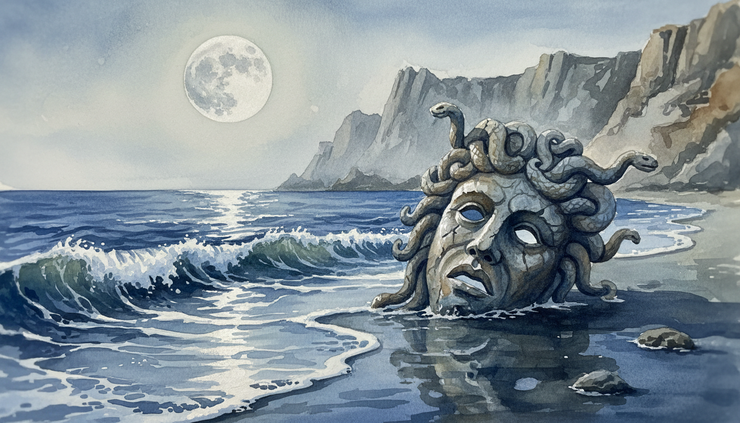
Medusa’s names reveal more than her monster mask
Ancient names and epithets often preserve meanings that the story alone does not explain. Medusa’s epithets show a figure who is not only feared, but also watched, guarded, and invoked as a power at the edge of human control.
The name Medusa is usually connected with the Greek root medein, meaning “to guard,” “to protect,” or “to rule over.” This matters. Before she is anything else, her name suggests a guardian. The terrifying face becomes a shield, not only a threat.
The broader term Gorgon comes from a word linked with grimness, dread, or something fierce to behold. In ancient art, the Gorgon face appears on shields, temples, armor, and household objects. This image, called a gorgoneion, was apotropaic, meaning it turned away evil. The face that frightened people also protected them.
Several names and descriptions deepen her character:
Epithet or name | What it suggests |
Medusa | The guardian, protectress, or ruler |
Gorgon | A dread being whose power lies in being seen |
Mortal Gorgon | Unlike her sisters, Medusa can die, which makes her story tragic |
Snake-haired | A being tied to danger, transformation, the underworld, and primal wisdom |
Fair-cheeked Medusa | A reminder that some traditions described her beauty as well as her terror |
Stony-eyed or deadly-gazed | Her look freezes, stops, and ends what approaches without permission |
Medusa’s gaze is one of the most famous powers in myth, but it can be read in more than one way. On the surface, it kills. Symbolically, it halts aggression. It refuses intrusion. It forces the viewer to confront what they fear.
That makes Medusa a rare mythic figure whose power is both defensive and devastating. She does not need to chase. She only needs to be seen.
Her origins begin before the Olympian order
In Hesiod’s Theogony, Medusa is one of the three Gorgon sisters, born to the ancient sea deities Phorcys and Ceto. Her sisters are Stheno and Euryale, immortal beings whose names suggest strength and wide-ranging movement. Medusa alone is mortal.
That single detail changes everything. She belongs to a terrifying divine family, but she can be killed. She is both otherworldly and vulnerable.
This early myth does not center on a curse or punishment. Medusa is already a Gorgon. She lives at the edge of the known world, far from ordinary human life. Perseus, aided by Athena, Hermes, and divine tools, is sent to kill her. He approaches while she sleeps, avoids her direct gaze by using a reflective shield, and beheads her.
From her blood come Pegasus, the winged horse, and Chrysaor, a figure often shown with a golden sword. Even in death, Medusa creates impossible life.
Medusa’s myth links horror and fertility, death and birth, fear and protection. Her severed head becomes a weapon, but also a sacred sign.
Perseus later uses the head to defeat enemies. Afterward, he gives it to Athena, who places it on her aegis or shield. This image is important. Athena, goddess of wisdom and warcraft, carries Medusa’s face as a protective emblem. The monster becomes divine armor.
In this older frame, Medusa is not simply a villain. She is a power that gods and heroes seek to control.

Ovid’s transformation changes the emotional center of the myth
The version many people know today comes from the Roman poet Ovid, writing much later than Hesiod. In Ovid’s Metamorphoses, Medusa begins as a beautiful maiden. Poseidon assaults her in Athena’s temple. Athena then transforms Medusa’s hair into snakes and makes her face deadly to behold.
This version is painful because punishment falls on the violated person rather than the violator. Modern readers often respond strongly to that injustice, and with good reason. Ovid’s tale turns Medusa into a figure of trauma, exile, and rage.
Ancient sources do not all agree on this origin. Some present Medusa as born monstrous. Others emphasize beauty, danger, or transformation. Myth is not a single fixed text. It is a living body of stories shaped by poets, cities, rituals, and politics.
Ovid’s version has had enormous influence because it gives Medusa an emotional arc. She becomes someone changed by violence and then feared for the visible signs of that change. Her snakes can be read as curse, armor, warning, or awakening.
This is why modern interpretations often reclaim Medusa. Instead of seeing her as a monster defeated by a hero, many see her as a figure whose rage has meaning. Her power says, “No closer.” Her face says, “Look at what was done.” Her gaze says, “You do not get to pass unharmed.”
Medusa in art, feminism, and contemporary spirituality
Medusa has become one of the most recognizable figures in modern mythic imagination. Artists use her to explore beauty and fear. Feminist writers read her as a symbol of patriarchal anxiety around powerful women. Survivors may find in her an image of protection after harm. Magical practitioners may approach her as a guardian, teacher, or spirit of boundaries.
These modern readings do not erase the ancient sources. They build conversations with them.
In contemporary spirituality, devotion to Medusa can take many forms. Some people honor her as a goddess, even though ancient Greek texts usually frame her as a Gorgon rather than an Olympian deity. Others approach her as a mythic power, an ancestral symbol, a protective spirit, or an archetype. The language varies, and that is fine. What matters is honesty about the framework being used.
Common themes in modern Medusa devotion include:
Protection
Medusa’s face turns away harm. Her image can be used as a ward at thresholds, on jewelry, or in altar art.
Boundaries
Her gaze teaches refusal. She is often honored by people learning to say no, leave unsafe situations, or stop shrinking themselves.
Survivor strength
Ovid’s Medusa speaks strongly to those processing trauma, especially when they seek a symbol of dignity after violation.
Shadow work
Medusa helps reveal anger, shame, fear, and grief without forcing them into politeness.
Sacred rage
Her anger is not random destruction. It is the fire that rises when something sacred has been crossed.
The phrase Medusa Unveiled Ancient Myth Epithets Modern Devotion and Witchcraft Practices captures this layered approach. To unveil Medusa is not to soften her. It is to see her whole.

How to work with Medusa in witchcraft
Working with Medusa in witchcraft calls for respect, patience, and clear intent. She is not a gentle aesthetic to borrow for drama. Her myths carry themes of death, violation, punishment, resistance, and protection. Approach her as a serious presence.
Spiritual practice is personal, and not everyone will understand Medusa in the same way. Some witches treat her as a deity. Some treat her as a spirit ally. Some use her image symbolically. Choose the approach that matches your beliefs and be consistent.
Build a protective altar
A Medusa altar does not need to be elaborate. Keep it focused and clean.
Useful items include:
A printed image, statue, or drawing of Medusa
Black, white, red, or deep green candles
A mirror, especially a small round one
Protective herbs such as rosemary, bay leaf, garlic skin, or rue, if you use it safely
Stones such as obsidian, hematite, serpentine, or smoky quartz
A bowl of salt or water
Snake imagery, shed snake skin if ethically sourced, or serpent jewelry
Written petitions for protection or courage
Place the altar near a room entrance if the work centers on warding. Place it in a private space if the work centers on healing, rage, or shadow work.
Practice mirror protection
The mirror belongs naturally with Medusa because Perseus could only approach her through reflection. In witchcraft, reflection can reveal, deflect, or contain.
A simple mirror ward can be done like this:
Cleanse a small mirror with smoke, sound, saltwater on a cloth, or another method you trust.
Hold it facing outward from your body.
Say a clear charm, such as:
“Medusa, guardian with the serpent crown, turn back harm before it reaches me.”
Place the mirror near a door, window, or altar, facing away from the center of the home.
Refresh the charm at the dark moon or whenever the space feels heavy.
This is a defensive practice. It focuses on keeping harm away rather than sending harm toward a person.
Use her image for boundary spells
Medusa’s power is strongly tied to boundaries. A practical spell can support real-world action, such as ending unwanted contact, speaking clearly, or protecting personal space.
Write one boundary on paper. Keep it short.
Examples:
“My no is complete.”
“My home is protected.”
“I do not answer what drains me.”
“Only respect may enter.”
Place the paper under a Medusa image or beneath a black candle in a safe holder. Light the candle and sit quietly. Imagine the snakes around Medusa’s head waking, watching, and guarding every direction.
Let the candle burn for a set time, then snuff it. Take one real action within 24 hours that matches the spell. Block a number, lock a door, send the message, cancel the plan, or tell the truth.
Magic works best when paired with behavior.
Honor her through offerings
Offerings can be simple and symbolic. Choose items that reflect protection, dignity, and respect.
Good offerings may include:
Fresh water
Black coffee or red wine, if appropriate for your practice
Pomegranate, dark berries, figs, or olives
Olive oil
Incense such as frankincense, myrrh, dragon’s blood, or rosemary
Poetry, art, or a written vow
Acts of protection for yourself or others
Avoid making vows you cannot keep. Medusa’s energy is often experienced as direct and uncompromising. Plain words are better than dramatic promises.
Try Medusa shadow work
Medusa’s myth is rich ground for shadow work because it touches fear, shame, beauty, rage, punishment, and being misunderstood.
Use journal prompts such as:
Where have I mistaken my anger for monstrosity?
What part of me became fierce because it had to survive?
Who benefits when I stay silent?
What gaze do I fear, and why?
What would change if I protected myself without apology?
This work can stir strong feelings. Move slowly. If trauma rises in a way that feels unmanageable, pause and seek support from a trusted person or qualified professional.

A respectful path with a fierce guardian
Medusa endures because she cannot be made simple. She is a monster in heroic myth, a guardian on ancient shields, a woman transformed in Roman poetry, and a modern icon of protection and survival. Her epithets reveal what the monster mask hides. She is the guardian, the dread face, the mortal Gorgon, the beautiful danger, the watcher at the threshold.
To work with Medusa is to take boundaries seriously. It is to honor the part of the self that refuses to be handled, silenced, or explained away. It is also to remember that protection carries responsibility. A shield is sacred because it guards life.
Begin simply. Light a candle. Speak her name with respect. Ask what must be protected now. Then listen for the answer that does not flatter, excuse, or soften the truth.


Comments